Chapter 14A — Approval flows
A leave application, an expense claim, a week of hours: each is a request that someone other than its author has to answer. Who answers is a rule most companies keep in their heads ("your manager, then HR, and Finance if it is large"), and it fails the day the manager is on holiday or the claimant has no manager at all. This chapter is that rule written down: the flows, the steps and approvers in them, what happens when nobody answers, and the inbox the approvers work from.
What this chapter covers
- 14A.1 The default flows
- 14A.2 Custom flows: conditions, priority and which one wins
- 14A.3 Steps and approver types
- 14A.4 Escalation and testing a flow
- 14A.5 The Approvals inbox, My requests and delegation
- 14A.6 Editing a flow that requests are travelling
The concept
An approval chain is the ordered list of people who must say yes before a request takes effect. Three ideas shape a good one. Separation of duties: whoever asks never decides, because a control its subject can operate is no control. Authority that grows with the stake: two days off need one signature, three weeks or a four-figure claim a second. Continuity: people leave, move teams and go on holiday, so a request must reach someone who can decide it today, and a decision owed by an absent approver needs a stand-in (delegation) or a rule for when the wait runs out (escalation). Where several people could decide one link there is a last choice: is one yes enough, or must they all agree?
How Operentra handles it
- Settings › Approval flows holds the flows: ordered steps, each naming an approver type. Approvers decide in the portal under Work → Approvals or on the module pages they already use, and on the final yes the module does what it always did.
- Six kinds of request travel a flow: leave applications (Chapter 48), expense claims (Chapter 66), shift swaps and drops (Chapter 35A), leave allocation requests (47.6), timesheets (Chapter 43A) and HR Desk requests of a type that needs approval (Chapter 81D). Each has a default flow; a custom flow adds conditions.
- Who:
approvals.configure(Super Admin, HR Manager) opens the page;approvals.delegate(those two, HR Officer, Accountant, Department Head) shows the Delegations tab. Deciding needs neither: the step says who, usually by a permission from Chapter 14. Work → Approvals itself is in every member's portal menu, with no permission. - Plan: the defaults, the test, the inbox and My requests are in every workspace. Creating, editing or deleting a flow (a default's steps included) and creating a delegation need Custom approval flows, which comes with the Growth and Enterprise plans (Appendix F).
Walkthrough
Northwind has the feature on. Beside the five defaults it has three custom flows: Long leave — manager, then HR and Personal hours — time-off officer for leave, and Large claims — manager, Finance, CEO for expenses.
14A.1 The default flows
Open Settings › Approval flows. Each kind of request has a section and each flow a row: its name, a Default badge or its priority, when it applies, its steps as numbered chips, and how many requests wait on it. The default is the rule the module applied before flows existed:
| Request | Step 1 | Step 2 |
|---|---|---|
| Leave applications | Anyone with leave.approve (direct reports only without leave.view_all) | none |
| Expense claims | Reporting manager holding expenses.approve_team | Anyone with expenses.manage |
| Shift swaps | Reporting manager holding roster.publish | Anyone with roster.publish |
| Leave allocation requests | Reporting manager holding leave.approve | Anyone with leave.allocate (direct reports only without leave.view_all) |
| Timesheets | Reporting manager holding timesheets.approve | Anyone with timesheets.manage |
| HR Desk requests | Reporting manager holding requests.approve | none |
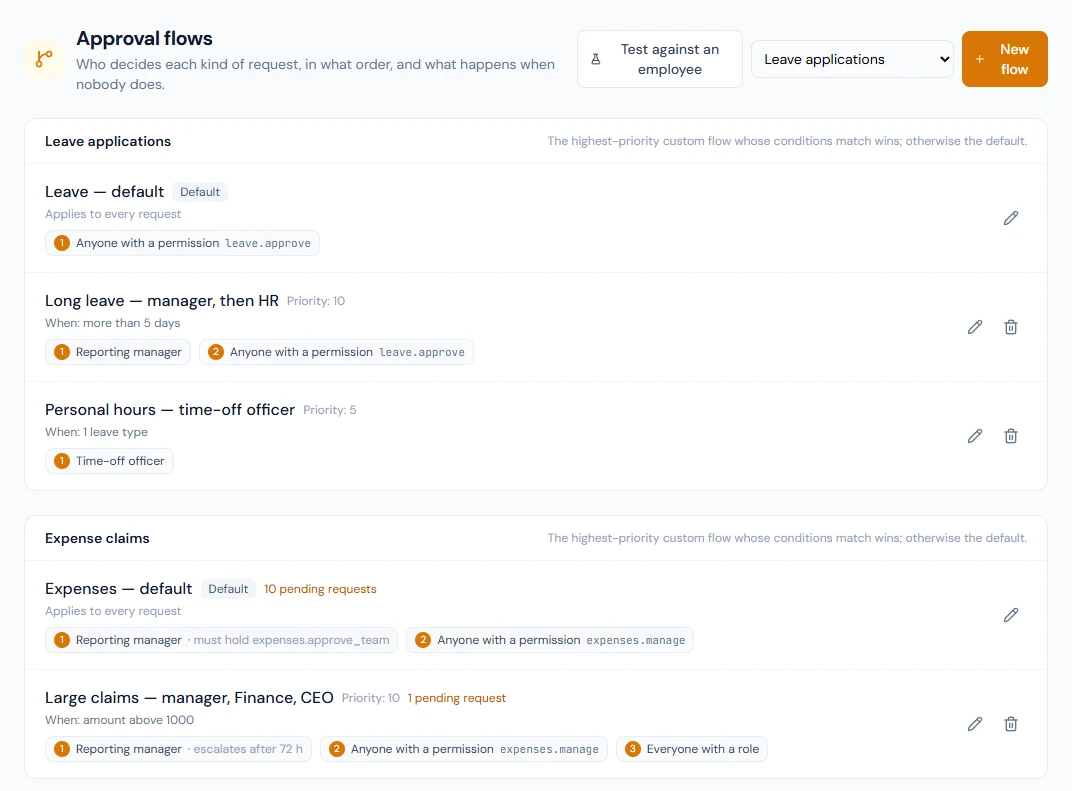
Holding is the step's The approver must also hold setting: the reporting line is not enough, and a manager whose role lacks the permission is passed over. A default cannot be deleted, switched off or given conditions: it is where a request lands when no custom flow fits.
14A.2 Custom flows: conditions, priority and which one wins
Pick the kind of request beside New flow and press it. A custom flow has a Name, a Priority (0 to 1,000), Conditions, an Active tick and Steps.
| Condition | Offered for | Holds when |
|---|---|---|
| Total amount above | Expense claims | The claim total is above the figure |
| Leave days above | Leave applications, allocation requests | The days asked for are above the figure |
| Only these leave types | Leave applications, allocation requests | The leave type is one of them |
| Only these departments | Every kind | The requester's department is one of them |
On submission, the active custom flows whose conditions all hold are ranked by priority, then name, and the first is used; if none holds, the default is. Above is strict: a flow for more than 5 days does not take a five-day application. A flow with no conditions reads Applies to every request and does so. A leave type pinned to a flow (45.9) overrides the ranking for that type. A shift swap and a timesheet carry no amount, days or leave type, so their flows can depend on the department only. A flow for HR Desk requests can depend on the request type and on the first amount of money entered on the form.
In Northwind the long-leave flow (When: more than 5 days, priority
10) is the reporting manager, then anyone with leave.approve. The
large-claims flow (When: amount above 1000, priority 10) is the
reporting manager, anyone with expenses.manage, then whoever holds
the Super Admin role. The officer flow has one step and priority 5. It
reads When: 1 leave type, which is Personal Hours, and that type is
pinned to it as well, so it takes Personal Hours and nothing else: a
two-day application of annual leave goes to the default.
14A.3 Steps and approver types
Add step adds a step, up to twenty, and the arrows reorder them. Each names who decides:
| Approver type | Resolves to |
|---|---|
| Reporting manager | The requester's reporting manager |
| Manager's manager | The reporting manager's own manager |
| Department head | The head set on the requester's department |
| Time-off officer | The officer on the requester's employee record |
| Everyone with a role | Every active member holding the role |
| A specific person | One named member, whoever asks |
| Anyone with a permission | Every active member holding it; with a scope permission, a holder who lacks that one reaches only their direct reports |
Six rules apply to every step, whatever its type:
| Rule | What it means |
|---|---|
| Anyone or everyone | The type says who is eligible; the mode says how many must answer. First decision settles the step, or Everyone resolved must approve: each person who can decide at that moment says yes. A rejection at any step ends the request. |
| Able to sign in | A step resolves only to members who can sign in. A deactivated member, one who has not accepted their invitation and one added with No portal login (Chapter 14) are left out, so no request waits on someone who cannot open it. |
| Nobody | A step that resolves to nobody (no manager, an empty role, a manager lacking the required permission or a portal login) is skipped for good. If the whole flow is empty the request travels the default; if that is empty too, the module decides as it did before flows. |
| Today, not then | Who can decide is worked out at the decision. A manager appointed yesterday can decide last week's request; someone who has lost the role cannot. |
| Not your own | The requester never decides while anyone else can. Leave and expense claims keep one exception: where nobody else in the workspace could, that person decides on the module's page, never in the inbox. |
| Out of turn | A later step's approver can decide on the module's page while an earlier step waits, and the steps between are recorded as passed over (66.4). |
In Northwind only the two support agents, NWL-0034 and NWL-0035, have a time-off officer: Ezekiel Thornbury (NWL-0033), who leads Customer Support. Their Personal Hours wait on him. For everyone else the officer flow's step is empty, and their Personal Hours travel the default.
Northwind also shows the sign-in rule at work. Most of its employees are HR-managed records with no portal login. Of the people this chapter names, four have one: Imani Castellanos, Solomon Nakamura, Rafferty Considine and Ezekiel Thornbury. A step that would name someone without one is skipped, so Imani's own requests pass over her reporting manager.
14A.4 Escalation and testing a flow
A step can carry a waiting time in Hours (1 to 720) and what happens when it runs out, checked hourly.
| Choice | When the time runs out |
|---|---|
| Notify (send an approval.escalated event) | One event goes to the workspace's webhooks (Chapter 97). The request stays where it is and nobody is emailed. |
| Approve automatically | An automatic approval completes the step, whatever its mode. |
| Skip to the next step | The step is recorded as unanswered and the request moves on. |
On the last step the second and third approve the request, because nothing is left to wait for. Northwind's large-claims flow gives the manager 72 hours, then notifies.
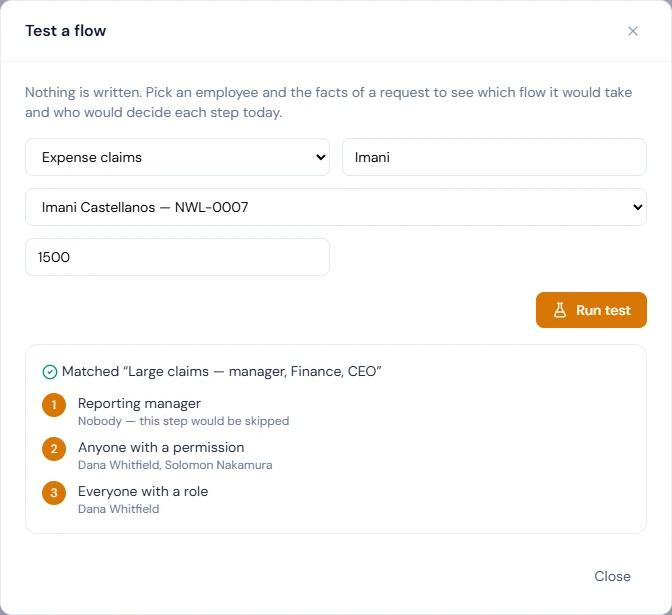
Test against an employee takes the kind of request, an employee and the facts that kind carries: leave days and type for a leave application or an allocation request, the claim total for an expense claim, the request type and an amount for an HR Desk request, nothing more for a shift swap or a timesheet. Run test shows the flow the request would travel and, for each step, who would decide today or Nobody — this step would be skipped; nothing is written. Imani Castellanos (NWL-0007) with a claim of 1,500 matches the large-claims flow; at 1,000, the default.
The test answers as a submission would. It follows a pinned leave type. When nobody can decide any step of the flow that matches, it says so and shows the default, which is the flow the request would travel; when the default has nobody either, it says no approval would start. Test Personal Hours for Imani: the officer flow matches, she has no officer, and the test shows the default.
14A.5 The Approvals inbox, My requests and delegation
Work → Approvals in the portal has three tabs.
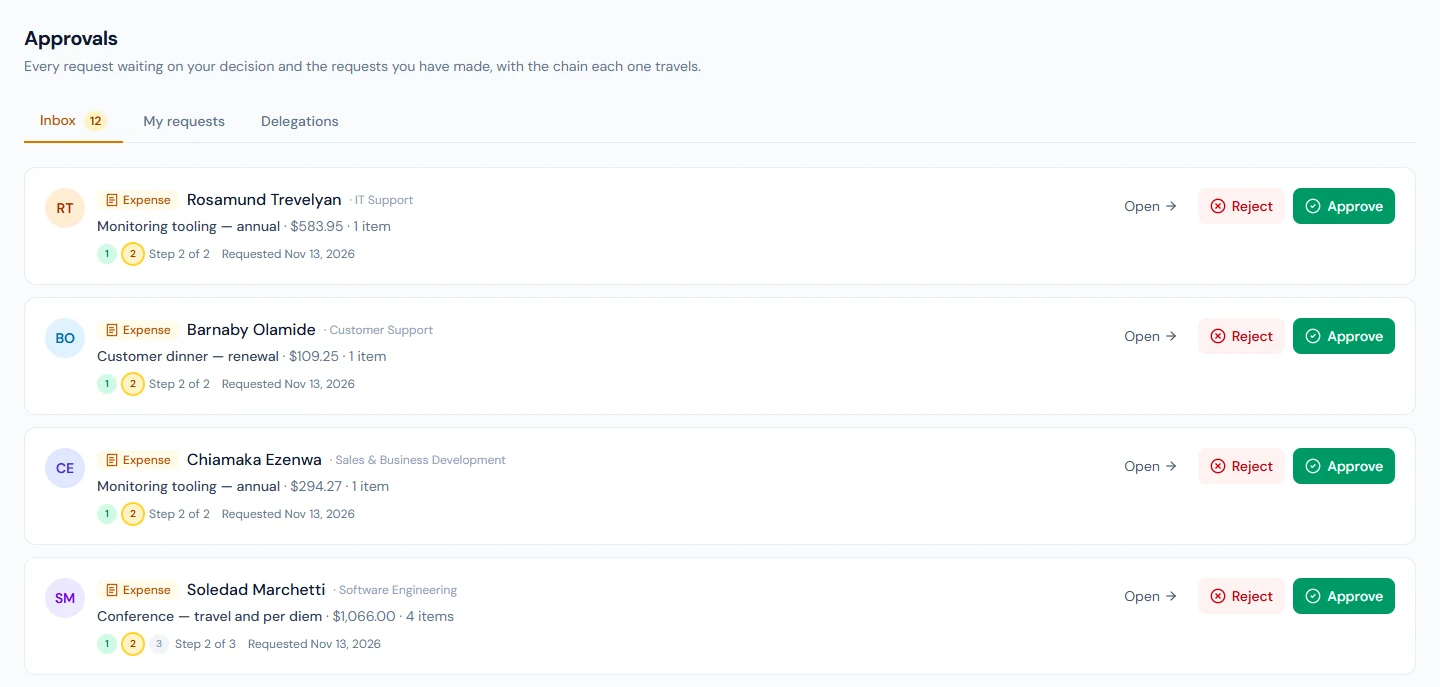
Inbox holds what waits on the signed-in person, oldest first: the
kind, who asked, what for, the chain as numbered dots with Step 1 of
2, and the date. Approve records a yes; on the last step the
module applies it. Reject asks for a Reason the requester will
see. Open is on a card only when the approver has a module page
that lists the request and lets them decide it: Pending Approvals or
Allocation Requests for someone with leave.view_all or for a direct
report, the claim's page or Team Expenses, the roster's Swaps tab,
Team timesheets. An approver with no such page, a time-off officer on
the Employee role for one, decides on the card. A person's own
requests are never listed, and a decision is
checked as it is made: if a colleague settled the step first, or the
person's role has changed, it is refused and the list reloads. My
requests lists the person's own, newest first, with the status, the
dots and the trail: Approved by a name, Step skipped: nobody could
decide it, and the rest.
Delegations is the stand-in. Delegate asks Delegate to, From, Until, Request types (none ticked means all) and a note. Between those dates, whole days on the workspace's calendar and at most a year, the colleague sees the delegator's requests marked on behalf of and decides what the delegator could, except a request of their own. The delegator ends it with the bin icon. In Northwind, Rafferty Considine (NWL-0020), the department head of Chapter 90, has delegated his leave approvals to Solomon Nakamura for a fortnight.
14A.6 Editing a flow that requests are travelling
Saving a flow re-routes the pending requests on it at once. If any are waiting, the editor first shows Requests are waiting on this flow with the count, and the button is Save and re-route.
- A request that has reached a step you changed (its approver, required permission or mode, or a step removed) starts again at the first step; its earlier approvals stay in the history and no longer count.
- A request that has not reached a changed step keeps its place.
- Changing only a waiting time or an escalation restarts nothing.
Conditions and priority are read at submission, so changing them moves no request already travelling. A flow with pending requests cannot be deleted.
What happens next
- The final yes hands the request back to its module, which deducts the leave, creates the claim's payroll addition, rewrites the roster, adds the allocation or approves the week. A withdrawn request shows as Cancelled.
approval.requested,approval.approved,approval.rejectedandapproval.escalatedgo to webhooks, and a connected chat channel can announce a new request (Chapter 95).- Chapter 15 turns to people who belong to more than one company.
What the employee sees
The requester follows a request on the module's own page: My Leaves, My Expenses, My Schedule, My Timesheet. Approvals is in everyone's portal menu, whatever their role, because a step can name anyone and My requests is each person's own. Imani Castellanos, on the Employee role, has two tabs: an Inbox that stays empty unless a step names her, and My requests. Solomon Nakamura, an HR Manager, has all three, with Rafferty Considine under Delegated to you while the delegation's dates last.
Common mistakes
- A custom flow with no conditions. It takes every request of its kind ahead of the default. Give it one, even when it exists for a pinned leave type: Only these leave types, with that type.
- A manager step with no required permission. It resolves to the manager whatever their role, and a manager on the Employee role then approves from an inbox card a request no page of theirs shows in full. Name the permission.
- Expecting Notify to chase the approver. It sends one event to webhooks and no email. Nothing moves unless a system is listening.
- Skip or auto-approve on the last step. The clock then approves the request.
- Leaving without a delegation. Nobody, HR included, can create one for somebody else. Set it before the holiday begins.
- Naming an approver who has no portal login. A step never resolves to them, so the request passes them by. Invite them first.
Practice
Steps 1 to 3 write nothing and are safe in the Northwind demo. Step 4 needs the Custom approval flows feature on a workspace of your own.
- Open Settings › Approval flows. Check each default against the table in 14A.1, then read the When line and the priority of the three custom flows.
- Test an expense claim for Imani Castellanos at 1,500 and at 1,000, then a leave application of 8 days for her, and Personal Hours for her and for Anastasia Ruvalcaba (NWL-0034). Say why each travels the flow the test names, and why Imani's Personal Hours do not travel the flow that matched.
- Sign in as Solomon Nakamura and open Work → Approvals. Read a card's dots, then My requests and Delegations.
- Create a leave flow for more than 10 days with two steps, the second set to Everyone resolved must approve, and test it.
Quiz
1. Two custom leave flows both match an application. Which is used?
The one with the higher priority; on a tie, the first by name. A leave type pinned to a flow overrides the ranking.
2. A claimant's reporting manager is on the Employee role. What does the default expense flow do?
It passes the manager over, because the step requires
expenses.approve_team, and the claim waits on anyone with
expenses.manage.
3. An HR Manager applies for leave. Can they approve it?
Not while anyone else can decide it. Only where nobody else in the workspace could, and then on the module's page, never in the inbox.
4. You change the approver of step 2. What happens to a request waiting at step 1, and to one at step 2?
The first keeps its place. The second starts again at step 1, and its earlier approvals stay in the history without counting.
5. What can a workspace without Custom approval flows not do?
Create, edit or delete a flow, or create a delegation. The default flows, the test, the inbox and My requests all work.