Chapter 50 — Payroll fundamentals
Payroll is the one process every employee audits every month, with the sharpest possible instrument: their own bank balance. It is also the process with the most arithmetic hiding behind the fewest screens. This chapter is the vocabulary and the shape of a monthly run, with Operentra's names for each piece, before Part 9 walks through components, structures, runs, payments and slips.
This chapter and the rest of Part 9 need the Payroll plan feature.
What this chapter covers
- 50.1 The pay cycle and the payroll calendar
- 50.2 From gross to net
- 50.3 Earnings, deductions, employer contributions
- 50.4 Taxable versus exempt pay; statutory bases
- 50.5 Controls: review, approval, locking
The concept
50.1 The pay cycle and the payroll calendar
A pay cycle is the period a payslip covers; Operentra pays monthly, one run per calendar month per workspace. A pay day is when the money moves, a date in the following days. Around those two sits a calendar of things that must be true before the run: the month's attendance complete and corrected, leave decided, increments and bonuses entered, new joiners assigned a salary, leavers settled. A payroll that starts before the calendar is done produces the corrections that erode trust; most of the discipline of payroll is sequencing, not calculation.
The fiscal year (Chapter 10) frames the cycle for tax: year-to- date figures, slabs and certificates run on it, which is why a workspace needs one open before its first run.
50.2 From gross to net
Gross is what the employee is owed for the month before anything is taken away; net is what is paid. Between them sit two kinds of reduction, those that follow from the month's attendance and those that follow from policy and law. The order matters:
- Start from the assigned gross and split it into its earning lines.
- Prorate for the month: days not worked that the policy does not pay (absences, unpaid leave, a joining date mid-month) reduce the pay, by a per-day rate.
- Apply deductions: statutory (tax, social security), contractual (provident fund), and incidental (a loan instalment, a lateness penalty, an adjustment).
- Add anything extra: a bonus, an expense reimbursement, overtime.
- What remains is net; the payslip shows every step.
The per-day rate and what counts as a payable day is a policy decision as consequential as any tax rule; Chapter 54 is about it.
50.3 Earnings, deductions, employer contributions
Every line on a payslip is one of three things. Earnings are paid to the employee: basic salary and allowances. Deductions are taken from the employee's pay: tax, the employee's share of social security or a provident fund, a loan instalment. Employer contributions are paid by the company on the employee's behalf and never reach the payslip's net: the employer's share of social security, the employer's fund contribution, a gratuity accrual. The third kind is easy to forget and expensive to miss, because it is part of the cost of employment and usually a statutory filing.
A line is defined once as a component, with how it is calculated (a fixed amount, a percentage of basic, a percentage of gross, or a formula), and assembled into a structure, the template that says which lines a kind of employee has. The employee is then assigned a structure and a gross, and the lines resolve to amounts.
50.4 Taxable versus exempt pay; statutory bases
Not every earning is taxed, and not every earning counts toward every statutory calculation. A component is taxable or not, and a taxable one may still carry an exemption, a portion free of tax up to a cap, as a percentage of basic or a flat amount. The taxable income the tax rule works on is the sum of the taxable lines after exemptions.
Separately, each statutory calculation has a base: social security contributions are a percentage of some lines and not others, provident fund is usually a share of basic, overtime pay is a rate derived from certain lines, gratuity accrues on basic. A component therefore carries base flags: whether it counts toward the social-security base, the provident-fund base, the overtime base, the gratuity base. Getting these right is what makes the statutory lines right without anyone recomputing them by hand.
50.5 Controls: review, approval, locking
A payroll run should move through states, and each state should be a different person's responsibility. Draft or review: processed, visible, correctable. Approved: checked by someone who did not process it, with the system refusing approval while a known problem remains. Locked: final; nothing on it changes, and any later correction is a new entry in a new month. Paid: disbursed, with the payment file and the slips following. The point of locking is not distrust; it is that a figure once paid and reported cannot quietly change, because the bank, the tax authority and the employee all hold a copy.
How Operentra handles it
- One run per month per workspace, processed from Payroll › Process, reviewed on its run page, then Approve, Lock and Mark as paid (Chapters 55 and 58). The pay day is a payroll setting (Chapter 53).
- Components (Chapter 51) are earnings, deductions or employer contributions, calculated as fixed, a percentage of basic, a percentage of gross, or a formula, with a taxable flag, an exemption mode and cap, an affects-gross flag, and four statutory base flags: social security, provident fund, overtime, gratuity.
- Structures (Chapter 52) bundle components with per-structure calculation and values; an employee is assigned a structure and a gross from an effective date, and the assignment is never edited, only superseded by an increment or a structure change.
- Proration (Chapter 54) is presence-based on calendar days: a per-day rate of gross over the days in the month, paid for worked days, half for half days, nothing for absences and unpaid leave, and rest days paid when bracketed by worked days.
- Tax is computed from the fiscal year's slabs and the country pack's rules, and only for an employee whose structure carries the TAX component; a structure without it is tax-free by design. Where the country levies no income tax, the whole tax area is absent.
- Pre-flight checks (Chapter 55) refuse approval while a blocker stands: no default shift, an employee with no shift or no attendance, no current fiscal year, no tax slabs where tax applies; warnings (a second default shift, people without a salary, heavy deductions) are shown and never block.
- Locking freezes a run; disbursement, the bank file and the slips come after.
- Who:
payroll.configurefor components, structures, settings and slabs;payroll.managefor processing, approving and paying;payroll.salary_view_allto see salaries;salary_slips.view_ownfor the employee's slips.
Walkthrough
Northwind pays forty-five people monthly on the 7th, on one structure, "Standard US (Federal Withholding)": the whole gross as Basic, federal income tax from the year's slabs, and FICA, employee and employer, computed at run time; state and local tax are not withheld, and the structure says so. Thirteen monthly runs stand in every state, which Chapters 54 to 59 open. This chapter reads one payslip with the vocabulary above.
Reading one payslip
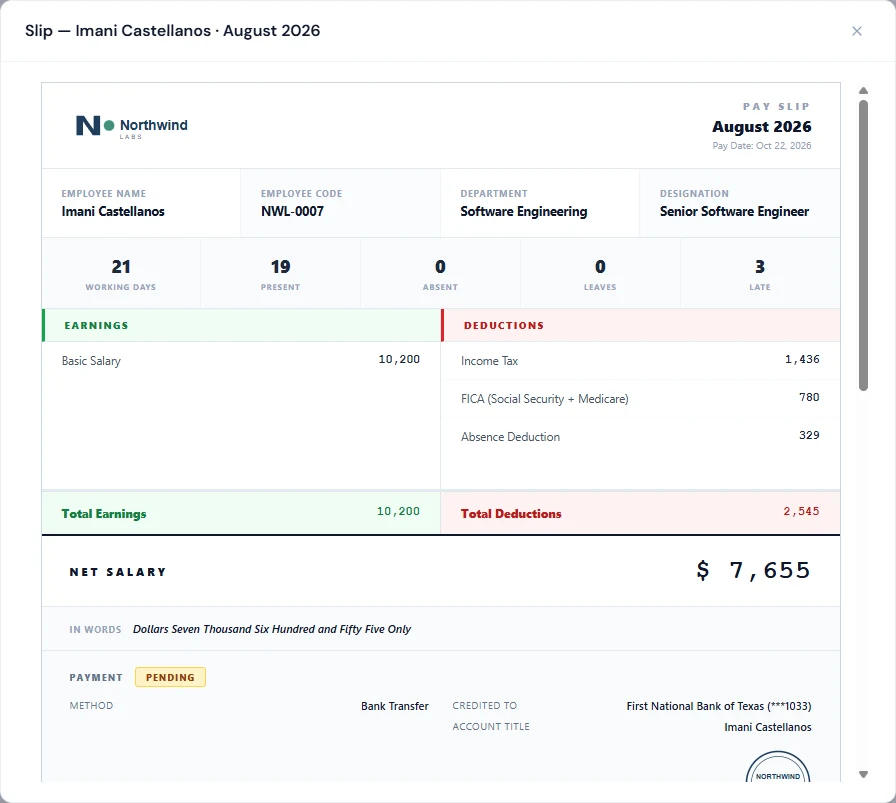
Take an engineer on a gross of 6,500. Earnings: Basic 6,500 (100% of gross). Proration: twenty-two working days, one absence on a Friday whose weekend then went unpaid, so the per-day rate of 6,500 over thirty-one days is docked three days. Deductions: federal income tax on the taxable income (Basic is taxable, no exemption) at the single-filer slabs with the standard deduction; FICA at the employee rate on the same base; nothing else. Employer contribution: FICA Employer, on the slip's employer side, not in net. Net: the remainder. The run page shows each of these as its own line, the attendance counts that drove the proration, and the tax computation (Chapter 54).
What happens next
- Chapter 51 defines the components, 52 the structures and assignments, 53 the settings; 54 is the calculation in detail, 55 the run, 56 to 62 the money around it.
What the employee sees
A payslip in the portal for each paid month with the earning, deduction and net lines, the attendance counts, and the tax computation where tax applies; an acknowledgment request; the year-to-date figures and, where tax applies, a tax certificate (Chapter 59).
Common mistakes
- Processing before the month is closed. Corrections afterwards are new entries; the sequencing is the control.
- Treating employer contributions as deductions. They are the company's cost and never reduce net.
- A taxable flag on an exempt allowance, or the reverse. The tax line is only as right as the flags.
- Base flags on allowances by habit. Social security, fund and gratuity bases are usually Basic alone.
- Assigning a structure without the TAX component by accident. The employee pays no tax; that is the design, so do it on purpose.
- Approving your own run. Approval is the second pair of eyes; give it to the person who did not process.
- Editing a locked month's figure by hand. It cannot be; the correction is an adjustment next month.
- Expecting pay day to pay anyone. It is a date on the slip; the bank file and the mark-as-paid step move the money.
Practice
Use your own trial workspace, not a customer's.
- Write the month's payroll calendar for your company in order: attendance closed, leave decided, changes entered, process, review, approve, lock, pay, slips.
- Open Payroll › Components and sort the seeded list into earnings, deductions and employer contributions; mark which are taxable.
- Open the structure and read how the gross splits into lines.
- Open a processed run, expand one employee, and follow gross to net line by line against 50.2.
- Find the run's status and who approved it.
Quiz
1. What are the three kinds of payslip line, and which never reaches net?
Earnings, deductions and employer contributions; the employer contribution is the company's cost and is never deducted from the employee's pay.
2. What is a statutory base?
The set of components a statutory calculation is taken on: social security, provident fund, overtime and gratuity each have one, flagged per component.
3. In what order does gross become net?
Split the gross into earnings, prorate for the month's attendance, apply deductions, add extras, and the remainder is net.
4. When does Operentra deduct income tax?
When the employee's structure carries the TAX component and the country levies income tax; a structure without it is tax-free by design.
5. Why lock a run?
So that a figure once paid and reported cannot change; later corrections become entries in a new month.