Chapter 61 — Provident fund and contribution funds
Some of what payroll deducts does not stay with the company: a provident fund, a pension scheme, a statutory social-security body. The money leaves each payslip, joins the employer's share, and has to arrive somewhere else, every month, in full. A fund in Operentra is the record of that journey: what each run owed the fund, what was paid in, what the fund's account holds, and, for a provident fund, what each member is owed. This chapter uses Dunebridge Technologies, the UAE demo company, which runs a staff provident fund; Northwind's US retirement saving is outside payroll and has no fund here.
What this chapter covers
- 61.1 Fund kinds: provident, pension, gratuity, social security, kept on books
- 61.2 Creating a fund: how it is paid, components collected, bank account, profit tax
- 61.3 Recording remittances
- 61.4 The PF ledger per employee: opening balance, profit, withdrawal, adjustment
- 61.5 Fund ledger entries: bank profit, tax, charges, loans to members
- 61.6 Bank statement checks; fund vs member balances
- 61.7 Sharing profit with members (and undo)
- 61.8 Fund transfers in the bank file; exporting the ledger
The concept
A fund has two balances that must agree. The fund's balance is money: what has actually been paid into its account, plus what the account earned, minus charges and withdrawals. The members' balances are promises: what each employee is entitled to from their own and the employer's contributions and their share of profit. The gap between them is the most important number in fund administration. A gap that equals the contributions of a month not yet paid in is normal; any other gap is money missing, owed, or recorded twice, and the trustee or the auditor will ask about it.
How Operentra handles it
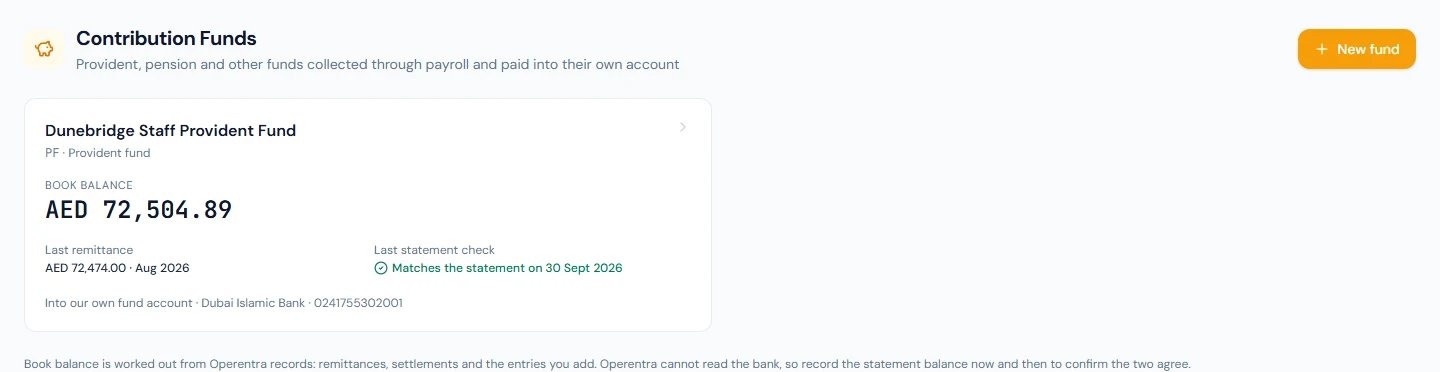
- Payroll › Funds lists each fund with its book balance, what is owed to members, the last remittance and the last statement check.
- A fund has a kind (provident, pension, gratuity, social security or other), a way of being paid each month, the salary components it collects, a start month, and, for one paid into its own account, that account; a provident fund can carry the tax rate the bank withholds on profit.
- Remittances are recorded automatically when a run is paid by bank transfer to a fund with its own account, or by hand with a reference for any other fund.
- The PF ledger keeps each member's balance from the runs'
PF_EEandPF_ERlines, plus opening balances, profit, withdrawals and adjustments. - The fund page has its own ledger, statement checks, the fund versus members comparison, and profit sharing with undo.
- Who:
payroll.salary_view_allto see funds and ledgers; to create funds and record entries,payroll.manage(Super Admin, Accountant).
Walkthrough
Dunebridge's Dunebridge Staff Provident Fund, code PF, is paid into
its own account at Dubai Islamic Bank, collects the PF_EE and PF_ER
components (5% of basic each, on the standard UAE structure) and starts
from 1 August 2026, with no profit tax. Forty-five members have August
and September contributions on their ledgers. The fund's ledger holds
the August remittance of 72,474 on 3 September, a bank charge of 52.50
on 30 September and bank profit of 83.39 on 1 October, not yet shared;
the September statement check matches the book. September's run is
locked but not yet paid.
61.1 Fund kinds: provident, pension, gratuity, social security, kept on books
The kind says what the fund is: a provident fund, a pension fund, a gratuity fund, social security or another statutory scheme, or other. Only a provident fund has member ledgers and profit sharing. More important than the kind is how the fund is paid each month, the first question when creating one:
| Answer | What happens |
|---|---|
| Into our own fund account | The fund's share of each run is paid into its own bank account as a row in the payroll bank file, and booked on the fund when the run is paid |
| To a government body | Paid to an authority by payment slip or online portal; you record each payment with its reference |
| To an outside provider | Paid to a pension provider or insurer; you record each payment with its reference |
| Kept on our books | Nothing is paid out monthly; the company owes the balance and pays it in the final settlement when someone leaves |
61.2 Creating a fund: how it is paid, components collected, bank account, profit tax
New fund asks how the fund is paid, then the Fund name, a
Code, the Kind, Starts from (runs for earlier months are not
remitted to it), the Salary components collected (the run total of
these is what goes into the fund; for a provident fund, usually the
employee and employer shares), the Fund bank account for a fund
paid into its own account (an account whose purpose is fund, Chapter
11), the Tax withheld on bank profit for a provident fund whose
bank deducts tax, and an optional opening balance with its date
when the account already holds money. The member ledgers fill only
from components coded PF_EE and PF_ER, so a provident fund's
components must use those codes (Chapter 51).
61.3 Recording remittances
For a fund paid into its own account, paying the run by bank transfer (Chapter 58) books the remittance: the bank file carried the fund's row, so Dunebridge's August run, paid on 3 September, wrote the 72,474 "Payroll remittance" with its source. A run paid any other way, or a fund paid to a government body or a provider, appears under Payroll runs not yet remitted with the amount to record; Record remittance takes the date paid and the payment slip or transfer reference. Until a run is remitted, its contributions are owed to the fund.
61.4 The PF ledger per employee: opening balance, profit, withdrawal, adjustment
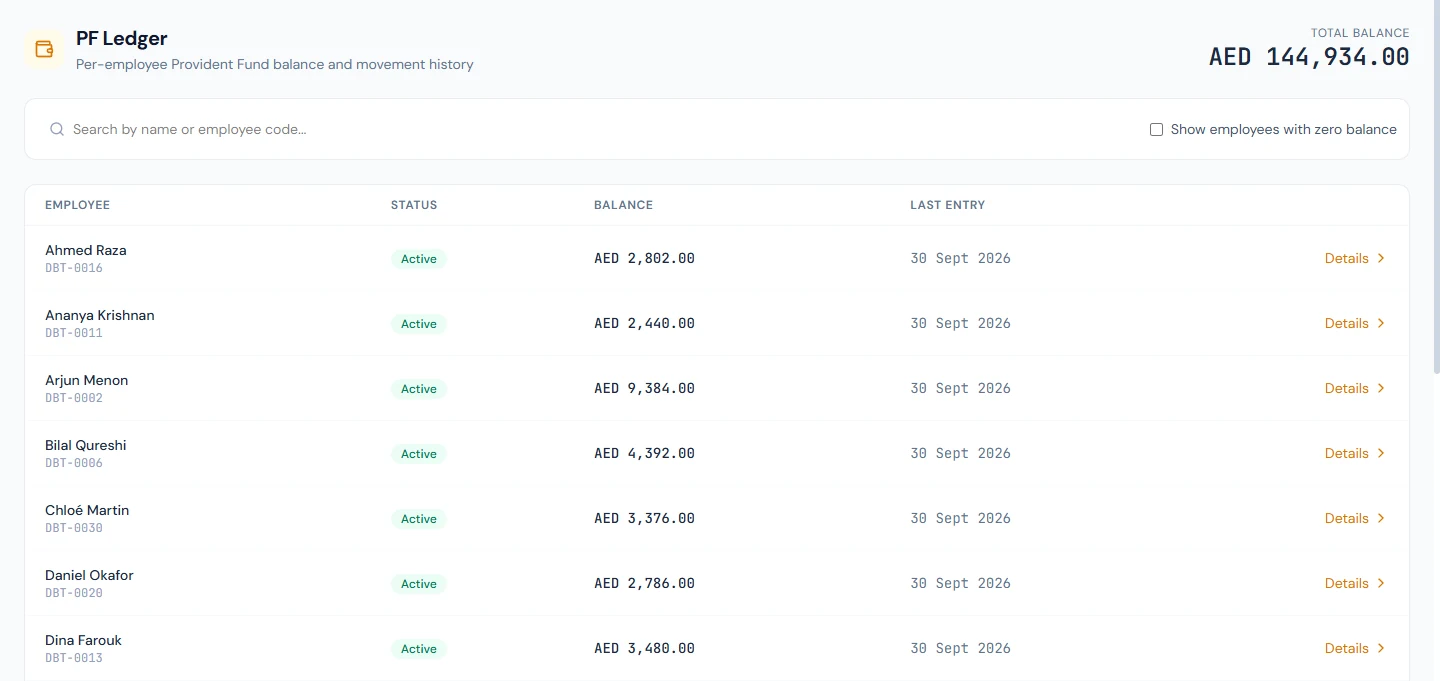
Payroll › PF Ledger lists members with their balance and last entry, a search and a switch to show zero balances; the total is at the top. A member's page shows every entry with its running balance and source: Employee Contribution and Employer Contribution from each run, and four entries HR adds: Opening Balance (a balance carried in from before), Credit fund profit (usually posted by sharing, 61.7), Record Withdrawal (a member's withdrawal under the fund's rules) and Adjustment (a correction, credit or debit), each with a reason. Payroll writes the contribution rows when a run is processed and rewrites them on reprocess; a leaver's balance is paid in the final settlement (Chapter 82).
61.5 Fund ledger entries: bank profit, tax, charges, loans to members
The fund's own page lists every movement of its money with a running Balance and its Source (a payroll month, a final settlement, or manual). Add entry records what the bank statement shows that payroll could not know: Bank profit (with the tax withheld on it, pre-filled at the fund's rate), Tax withheld on profit, Bank charge, Loan to member and Loan repayment, and Adjustment in either direction. An entry can name the member whose money it is, so it counts toward that member when profit is shared. Dunebridge's charge of 52.50 and profit of 83.39 were added this way.
61.6 Bank statement checks; fund vs member balances
Record statement balance enters the closing balance from the fund account's statement on a date; it does not change the book, it shows the difference. Dunebridge's check of 30 September, 72,421.50, equals the book on that date (the remittance less the charge), so the card reads that it matches.
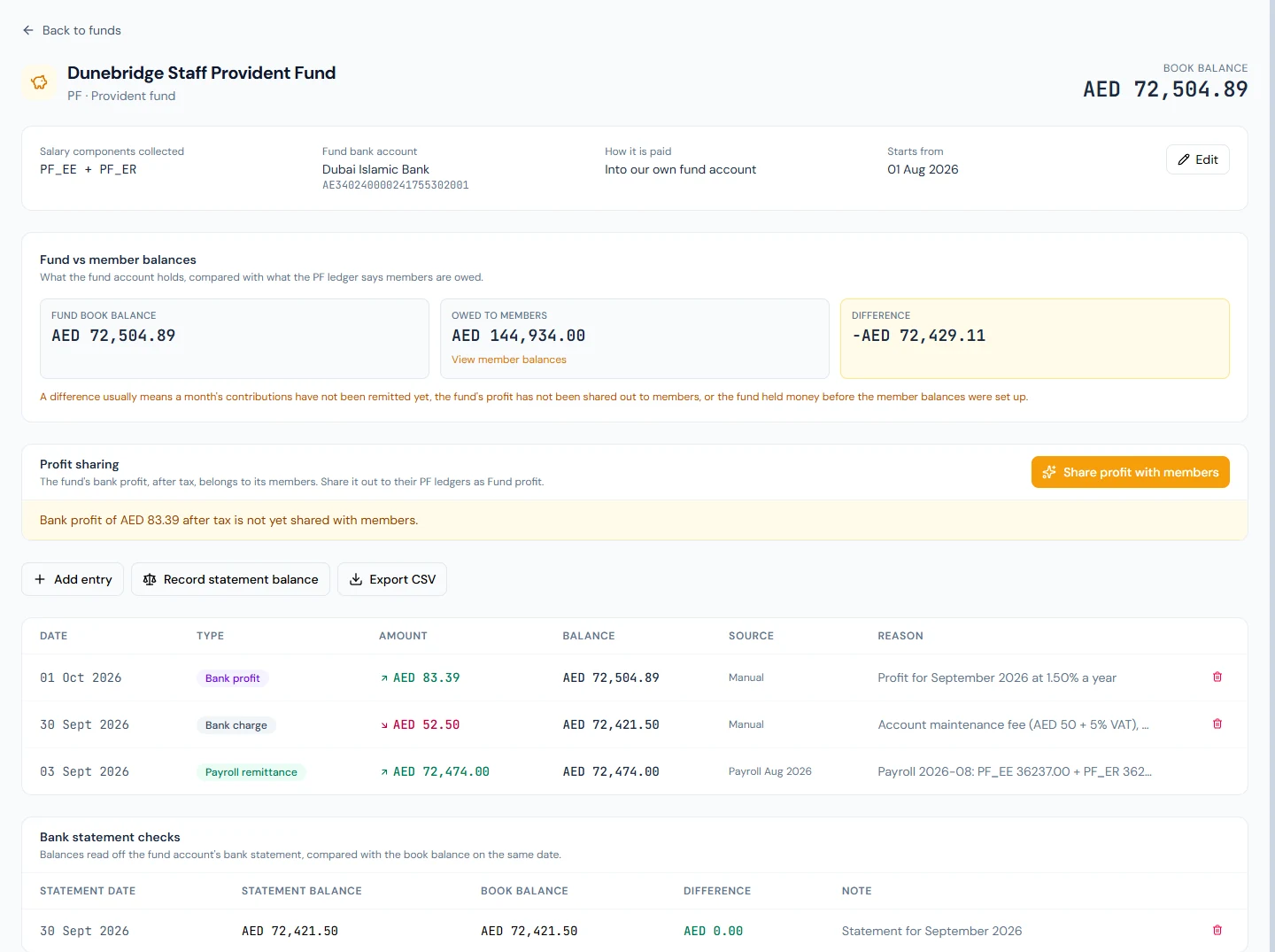
Fund vs member balances compares the book balance with what the PF ledger says members are owed. Dunebridge's book is 72,504.89 and its members are owed 144,934, a difference of 72,429.11. That difference is September's contributions, 72,460, which the September run collected on the slips but which reach the fund only when that run is paid, less the 30.89 of profit net of the charge that the fund earned and has not yet shared. A difference you cannot explain this way is the one to investigate.
61.7 Sharing profit with members (and undo)
The Profit sharing card says when bank profit after tax is not yet shared. Share profit with members treats each unshared profit credit as earned over the month before it was credited and splits it by each member's daily balance in the fund account over that month: a remittance counts from its date, an entry that names a member counts for that member, and company money counts for nobody. The dialog lists each member's share; choose the date for their entries and Share profit posts a Fund profit row to every member's PF ledger. Undo removes those rows so the profit can be shared again. Dunebridge's 83.39 of 1 October is September's profit, shared over the balances the August remittance created from 3 September.
61.8 Fund transfers in the bank file; exporting the ledger
For a fund paid into its own account, the run's bank file (Chapter 58) carries one more transfer: the fund's share, employee and employer, from the paying account to the fund's account, routed like an employee's pay and listed under Fund transfers in this file, with the file total covering salaries and funds. A fund the paying account cannot route to is skipped with the reason. Export CSV on the fund page downloads its ledger for the trustee or the auditor.
What happens next
- Paying September's run (Chapter 58) books its remittance and closes the gap in 61.6.
- The final settlement (Chapter 82) pays a leaver's PF balance and records the payout on the fund.
What the employee sees
The PF lines on their slip and, on the slip's statement page, their fund balance to date; their PF ledger is HR's record.
Common mistakes
- Components with other codes. The member ledgers fill only from
PF_EEandPF_ER. - Paying the run by cheque or cash. The fund's remittance is not booked; record it by hand with the reference.
- Recording profit net. Enter the profit and its tax separately, as the statement does, so the share uses the right figure.
- Sharing profit before the month's remittance is in. The split follows the balances actually in the account.
- Treating the book balance as the bank balance. It is a book; the statement check is the bank.
- Ignoring an unexplained gap. Find it while the month is fresh.
- Back-dating a fund's start. Runs before Starts from are not remitted; carry earlier money in as an opening balance.
Practice
Use your own trial workspace, not a customer's.
- Add a fund account (Chapter 11) and
PF_EE/PF_ERcomponents on a structure (Chapters 51 and 52). - Create a provident fund paid into its own account, starting this month, with an opening balance.
- Process, lock and pay a run by bank transfer; read the remittance on the fund and the contributions on a member's PF ledger.
- Add a bank profit with tax and a bank charge; record a statement balance and read the difference.
- Share the profit, read a member's ledger, and undo it.
Quiz
1. What are the two balances of a fund, and why must they agree?
The book balance of money in the fund and the members' entitlements on the PF ledger; a difference other than unremitted contributions is money missing, owed or double-counted.
2. When is a remittance booked automatically?
When a run is paid by bank transfer and the fund is paid into its own account, because the bank file carried the fund's row.
3. Which components fill the member ledgers?
Those coded PF_EE and PF_ER.
4. How is bank profit split between members?
Net of tax, over the month before it was credited, by each member's daily balance in the fund account.
5. What does a statement check change?
Nothing in the book; it records the bank's balance and shows the difference.