Chapter 2 — The language of HR
HR has a vocabulary, and most of it is precise. Gross and net are not synonyms; leave year and fiscal year can differ; probation and fixed-term describe different things. This chapter defines the terms the course uses from here on, with an example from Northwind Labs for each, and says where each one lives in Operentra.
What this chapter covers
- 2.1 Employment types, probation, confirmation and notice
- 2.2 Gross pay, net pay, employer cost, and taxable versus exempt pay
- 2.3 Statutory contributions, provident funds, gratuity and end-of-service
- 2.4 Fiscal year, leave year, accrual, carry forward and encashment
- 2.5 Grades, designations, reporting lines and cost centres
2.1 Employment types, probation, confirmation and notice
Employment type describes the shape of the relationship: permanent, fixed-term, part-time, intern, consultant. The type decides a great deal downstream: whether the contract has an end date, which benefits apply, sometimes which tax and contribution rules apply.
Probation is the trial period at the start of employment, typically one to six months, during which either side can end the relationship on short notice. Confirmation is the decision, at the end of probation, that the employee stays. It is usually recorded with a date and a letter, and it often unlocks benefits that probationers do not get.
Notice period is the time between someone announcing that the employment will end and the day it ends. It runs both ways: the employee gives notice when resigning, the employer when terminating. The length is set by the contract or by law, and often grows with seniority. The last day of the notice period is the last working day, the date most exit paperwork is keyed to.
At Northwind: Imani Castellanos is a permanent senior engineer. A new support analyst joined on a three-month probation; on confirmation, Dana recorded the confirmation date and issued a confirmation letter. Two contractors are on fixed-term contracts that end twelve months after they started.
In Operentra: employment types are a list you define under Company (with options such as whether accommodation or meals are provided). A contract carries a type (permanent, fixed term, probationary or consultant), a start date, an end date for fixed-term work, and a probation length in months. The Probations page lists everyone whose probation is ending; confirming an employee records the confirmation date and can issue the confirmation letter automatically. A separation records the last working day.
2.2 Gross pay, net pay, employer cost, and taxable versus exempt pay
Gross pay is what the employee earns before anything is taken off: the salary and allowances in their contract, plus overtime, bonuses or other additions for the month, minus the days not worked where the policy docks them.
Deductions come off the gross: income tax withheld, the employee's share of social-security contributions, their share of a pension or provident fund, loan instalments, and anything else they owe.
Net pay (take-home pay) is gross minus deductions. It is the figure on the bank transfer.
Employer cost is what the employee costs the company: the pay actually earned, plus the employer's own contributions on top (the employer share of social security, pension or fund contributions, insurance). It is always more than gross and is the number that matters for budgets. Some countries call it cost to company; Operentra calls it Total Employer Cost.
Taxable versus exempt pay. Not every part of gross pay is taxed. Most countries exempt some allowances, up to a limit or entirely: a medical allowance up to a percentage of basic, a transport allowance up to a flat amount, an expense reimbursement in full. The taxable base is gross pay with the exempt parts removed, and income tax is calculated on that. Getting the split right is most of what makes a payslip correct.
At Northwind, illustrative figures: Imani's gross is $6,000 a month. US social security and Medicare (FICA) take 7.65 percent, $459. Federal income tax withholding, say $640 for this example, depends on Imani's filing details. The net is $6,000 − $459 − $640 = $4,901. Northwind also pays its own FICA share of $459, so Imani's employer cost is $6,459 before any benefits.
In Operentra: gross pay is built from salary components (basic, allowances, deductions, employer contributions), each flagged as taxable or not, with exemption rules where a country allows them. A monthly payroll run produces, per employee, the gross, each deduction as its own line, the net, and the employer cost. Part 9 covers all of it.
2.3 Statutory contributions, provident funds, gratuity and end-of-service
Statutory contributions are amounts the law requires to be paid to a public scheme on the employee's wages: social security and Medicare in the United States, National Insurance in the United Kingdom, pension and employment insurance in Canada, and their equivalents elsewhere. Usually there is an employee share, deducted from pay, and an employer share, paid by the company on top. Rates, ceilings and who is covered are set by statute and change, often every January.
A provident fund is a savings scheme, statutory in some countries and voluntary in others, where the employee and the employer both contribute a percentage of salary each month into a fund held for the employee, paid out when they leave. The company keeps a ledger of each member's balance.
Gratuity and end-of-service benefit are lump sums paid when employment ends, calculated from length of service and the final wage. Several countries require them by law, usually after a minimum number of years; the formula and the wage it is based on differ by country, and the award is sometimes reduced when the employee resigns rather than being let go.
At Northwind there is no gratuity and no provident fund; US law requires neither. The company's statutory contribution is its FICA share. Dunebridge, the course's second example company in Dubai, pays an end-of-service award by law and runs a voluntary provident fund for its staff.
In Operentra: the workspace's country pack carries the statutory rules for the company's country: which contributions exist, their rates and ceilings for each year, whose pay they come out of, and whether there is a gratuity rule and what its formula is. Payroll applies them as deduction and employer-contribution lines on the payslip. Contribution funds keep the ledger for a provident fund and pay out from it at settlement. The Statutory coverage card in workspace settings says which of these Operentra automates for your country and which you handle yourself; Chapter 3 reads it.
2.4 Fiscal year, leave year, accrual, carry forward and encashment
The fiscal year is the twelve months a company's accounts, and usually its tax reporting, are organised around. It is January to December in many countries and something else in others: April to March, July to June. The fiscal year decides which year a payslip's tax belongs to, when year-end tax documents are produced, and how reports are grouped.
The leave year is the twelve months a leave entitlement is granted for. It is often the same as the fiscal year, but a company can choose the calendar year or each employee's anniversary instead.
Accrual is how an entitlement builds up. An annual allocation gives the whole year's leave on day one; monthly accrual adds a twelfth each month. A new joiner usually gets a pro-rata entitlement for the part of the year they are present.
Carry forward is unused leave moved into the next leave year, usually capped at a number of days. Encashment is unused leave paid out as money instead, at a rate per day the policy sets; it happens at year-end under some policies and at exit under most.
At Northwind the fiscal year is the calendar year. Annual leave is allocated at the start of the year; up to five days can be carried forward; the remaining balance is encashed when someone leaves.
In Operentra: Fiscal years are set up under Company, and one is current at a time. Leave is allocated per leave policy, which sets the days per year, whether carry forward is allowed and its maximum, and whether encashment is allowed and at what rate: days of the employee's basic pay, or a fixed amount per day. The year-end rollover allocates the new year's leave and calculates carry-forward. The Leave encashment page pays out a balance at the policy's rate, and a final settlement encashes the remaining balance at exit.
2.5 Grades, designations, reporting lines and cost centres
A designation is a job title with a place in the structure: Senior Software Engineer, HR Manager, Support Analyst. It usually carries a level and a job description.
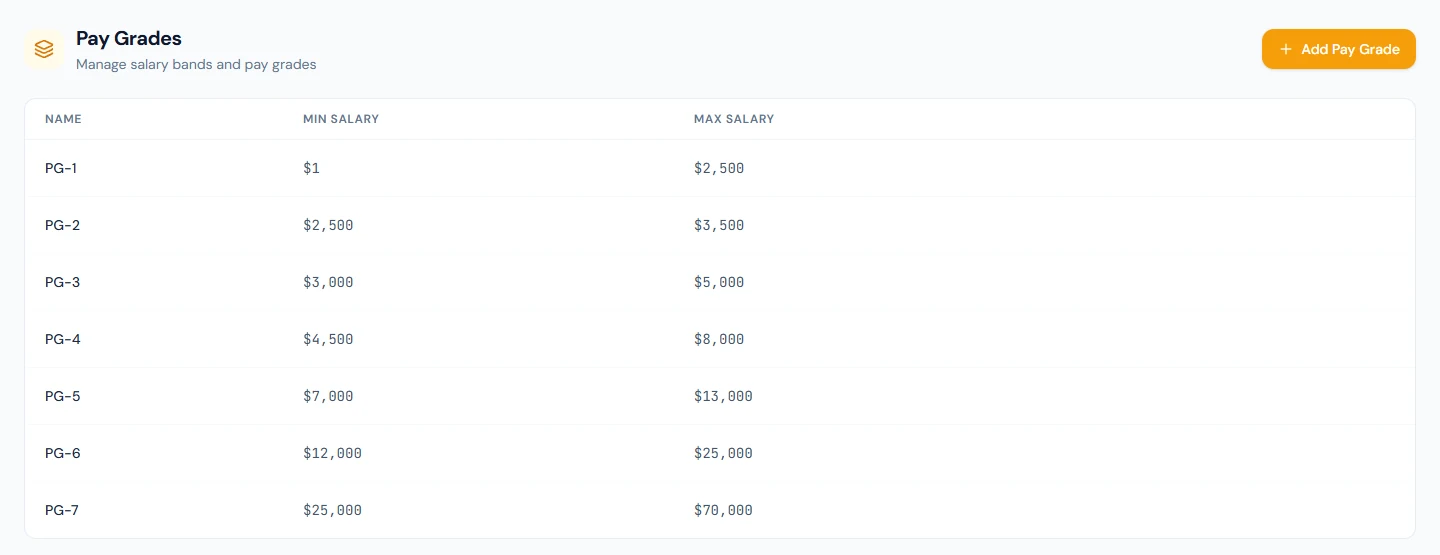
A pay grade is a salary band: the minimum and maximum a designation at that level is paid. Grades keep pay consistent across people doing comparable work and give a frame for offers and increments.
A reporting line is who an employee reports to. It decides who approves their leave, expenses and attendance corrections, who reviews their performance, and how the org chart is drawn. Every employee should have exactly one.
A cost centre is the accounting bucket an employee's cost is charged to, usually the department. Finance uses it to see what each part of the company costs; HR's job is to keep every employee in the right one.
At Northwind there are twelve departments, each with a cost-centre code. Imani is a Senior Software Engineer in Engineering, reporting to the engineering manager, which is why the engineering manager sees Imani's leave requests and nobody else's.
In Operentra: departments form a hierarchy and carry a cost centre; designations have a level, a pay grade and a job description that flows into employment agreements; pay grades hold the salary bands; each employee has a reporting manager. Approvals, the manager's portal views and the org chart all follow the reporting manager. Chapter 9 sets up the structure.
Common mistakes
- Quoting net when the contract says gross, or the other way round. Every offer, contract and increment should say which, and gross is the convention.
- Forgetting the employer's share when costing a hire. A $6,000 salary is never a $6,000 cost.
- Treating every allowance as taxable (over-withholding) or every allowance as exempt (under-withholding). The split comes from the law, not from the name of the allowance.
- Leaving probation open-ended. If nobody confirms the employee, benefits that depend on confirmation never start, and the question of whether they passed is answered by default.
- Two reporting managers, or none. Approvals go to the wrong person, or to nobody.
Practice
- Take any payslip you have access to, your own will do, and label each line as gross, deduction, net or employer cost. If a line does not fit, work out why.
- For the same payslip, mark which earning lines were taxed and which were not. If you cannot tell, that is the point: it should be visible.
- Write down your own country's fiscal year, the leave year your employer uses, and whether unused leave is carried forward, encashed, or lost. You will enter these in Chapters 10 and 45.
Quiz
1. Gross pay is $5,000, deductions are $900, and the employer pays $380 of contributions. What are net pay and employer cost?
Answer
Net pay is $4,100 (gross minus deductions). Employer cost is $5,380 (gross plus the employer's own contributions). The $900 deducted from the employee is not an employer cost; it was already inside the $5,000.
2. An employee on a three-month probation reaches the end of it and nobody does anything. What is the risk?
Answer
Confirmation never happens, so anything keyed to it — benefits, the confirmation letter, in some countries the notice period — never starts, and the question of whether the employee passed probation has been answered by neglect.
3. What is the difference between carry forward and encashment?
Answer
Carry forward moves unused leave into the next year as days, usually up to a cap. Encashment pays the unused leave out as money at a rate per day.
4. Which single field decides who approves an employee's leave in Operentra?
Answer
The employee's reporting manager.
5. A company in a country with no statutory gratuity still wants to pay one. Is that an HR concept or a payroll one?
Answer
Both. The entitlement is an HR policy; the calculation and payment at exit are payroll. Operentra computes a gratuity where the country pack has a rule; elsewhere a voluntary award is paid as a settlement line.