Chapter 3 — Employment compliance basics
Every country regulates employment, and the rules reach into every HR function: what a contract must say, how many hours can be worked, what leave is owed, what must be withheld from pay and sent to the government, and what records must be kept and for how long. Software can carry the data and apply the rules; it cannot know which rules apply to a company it has never heard of unless told. This chapter sets out the obligations in general terms, and ends with the one screen in Operentra that says, for your workspace, what is automated and what is yours.
This chapter describes the kinds of rules employers face. The rules themselves depend on your country, often on your state or province, and they change. Treat the examples as examples.
What this chapter covers
- 3.1 Contracts and what they must contain
- 3.2 Working time, overtime, rest days and public holidays
- 3.3 Leave entitlements
- 3.4 Payroll tax and social security
- 3.5 Record keeping, retention and data privacy
- 3.6 What software automates versus what stays your responsibility
3.1 Contracts and what they must contain
An employment contract is the agreement that creates the relationship. Many countries require it in writing, or require a written statement of its main terms within a set time of the start date; others, including the United States for most private employers, do not require a written contract at all but treat one as binding when it exists. Either way, a written contract protects both sides, and a good one contains:
- the parties: the legal name of the employer and the employee;
- the job: title, duties, place of work, reporting line;
- the dates: start date, end date for fixed-term work, probation period;
- the pay: amount, currency, frequency, how allowances and overtime work;
- working time: hours, days, rest days;
- leave: annual, sick, and any other entitlements;
- notice and termination: notice periods both ways, grounds for dismissal;
- confidentiality, intellectual property and any restrictive terms;
- the governing law.
A contract signed on paper and a contract accepted electronically are both contracts in most jurisdictions, provided the acceptance can be shown to be the employee's. What matters is the evidence: who accepted, when, from where, and which version of the text.
In Operentra: contracts are generated from a template for the company's country and the employee's record, so the names, dates, designation and job description are filled in rather than typed. The employee accepts the contract in their portal, and the acceptance is recorded with the time and the address it came from; a signed paper copy can be uploaded instead. Fixed-term contracts carry an end date, the contracts list shows which ones are ending soon, and a contract can be renewed. Chapter 31 covers it.
3.2 Working time, overtime, rest days and public holidays
Working-time law sets how much work can be asked for and what extra work costs. The usual elements are:
- a standard working week, commonly 40 hours over five days, sometimes 48 over six;
- overtime, paid at a premium for hours beyond the standard; in the United States the federal rule is one and a half times the regular rate for hours over 40 in a week for employees the law does not exempt;
- rest days, at least one in each week, and daily rest between shifts;
- public holidays, which a country declares and which are paid days off in some countries and, in others such as the United States, a matter of company policy rather than law.
A company needs its own rules on top: what time the day starts, how much lateness is tolerated, whether overtime needs approval in advance, which days are the weekly offs for each team.
In Operentra: shifts define the working day and the weekly off days, and each employee is assigned one. Attendance settings set the grace period, the late thresholds and whether overtime needs approval. The holiday calendar holds the company's public holidays, and Operentra can suggest the official ones for the company's country each year. Attendance is measured against the shift, and the result feeds payroll. Part 7 covers it.
3.3 Leave entitlements
Most countries set minimum leave that an employer must grant: paid annual leave (a number of days or weeks per year), sick leave, maternity and paternity or parental leave, and sometimes others such as bereavement or study leave. The United States is unusual in having no federal requirement for paid annual leave; most US companies offer it as policy, and some states require paid sick leave.
A company's leave policy sits on top of the law: it can be more generous, never less. The policy says, for each leave type, how many days a year, how they accrue, whether unused days carry forward or are paid out, who approves, and what evidence is needed.
In Operentra: leave types and their policies are set per workspace, and employees are grouped so that different groups can have different policies. Where Operentra has a statutory leave set for the company's country, the workspace starts with it; otherwise it starts with a neutral set to edit. Which of the two you have is shown on the coverage card in 3.6. Part 8 covers leave.
3.4 Payroll tax and social security
In most countries the employer is the tax collector for employment income: it calculates the tax due on each payslip, withholds it, pays it to the tax authority, and reports it, typically monthly or quarterly during the year and in an annual statement per employee. Social-security contributions work the same way, with the employer paying its own share on top. The obligations are:
- register as an employer with the tax and social-security authorities;
- withhold the right amounts from each payslip, using the current year's rates, bands and ceilings;
- pay and file on time;
- issue year-end statements to employees (the W-2 in the United States, the P60 in the United Kingdom, and their equivalents elsewhere).
Rates and bands change every year, and in federal countries there is more than one authority: a US employer withholds federal income tax and FICA and, depending on the state, state and sometimes city income tax as well.
In Operentra: the country pack supplies the statutory rules the payroll engine applies: the income-tax bands where Operentra ships them, the social-security contributions with their rates and ceilings per year, and the employer's share where the law levies one. For the United States the pack covers federal income tax and FICA; state and local tax are the company's to handle, and the workspace says so. Year-end tax certificates are produced from the payroll records in countries where tax is withheld through payroll. Chapter 63 covers tax; the coverage card below says what applies to your workspace.
3.5 Record keeping, retention and data privacy
Employers must keep records, and keep them for a while. What and for how long is set by employment, tax and social-security law, and the periods are usually years: US federal rules, for example, require payroll records to be kept for at least three years. Typical records are the contract and its amendments, identity and right-to-work evidence, attendance and hours, payslips and tax filings, leave, accidents, and disciplinary matters.
The same records are personal data, and data-protection law applies to them: the GDPR in the European Union and the United Kingdom, and a growing number of state laws in the United States. The common duties are to collect only what is needed, to tell employees what is held and why, to keep it secure and accurate, to limit who can see it, to keep it no longer than needed, and to delete it properly when the time comes. An employee can usually ask what is held about them.
Keeping records and deleting them in time are the same discipline: knowing what you hold, where, and why.
In Operentra: the employee record and its documents are the system of record, with a per-employee view of which required documents are present, verified, or missing. The audit log records who changed what and when. Access is limited by roles and permissions, and a workspace can require two-factor sign-in. Workspace backups protect the data, and the data protection tools let the company export or erase an employee's data when the law requires it. Chapters 22, 91 and 92 cover these.
3.6 What software automates versus what stays your responsibility
Everything above is a rule of some country. Operentra holds statutory data for some countries and applies it automatically; for others it runs with a generic set-up where the company enters its own rules. Both work. The difference is whether the statutory data comes from Operentra or from you, and the one thing an HR person must never do is assume.
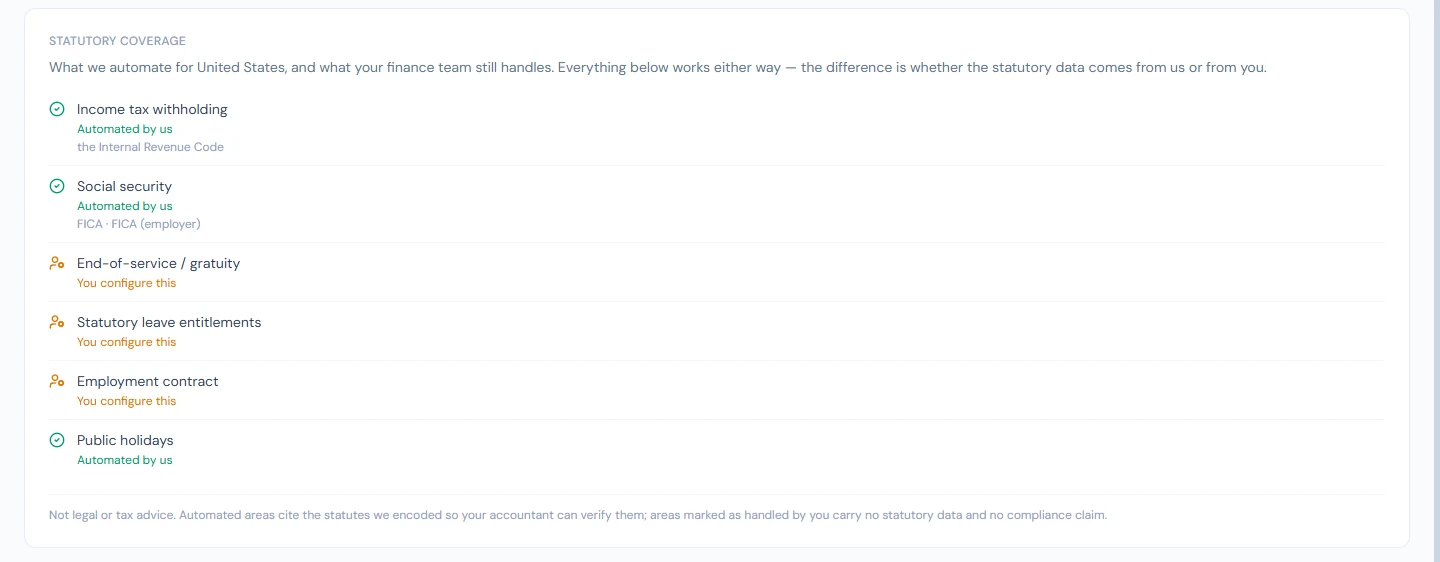
The Statutory coverage card answers the question for your workspace. It is under Settings › Workspace, on the Overview tab, and it lists six areas:
| Area | What it covers |
|---|---|
| Income tax withholding | Whether income tax is calculated and withheld on payslips |
| Social security | Employee contributions such as FICA, National Insurance, CPP and EI |
| End-of-service / gratuity | A statutory award at exit |
| Statutory leave entitlements | A leave set based on the country's law |
| Employment contract | A contract template that cites the country's law |
| Public holidays | The country's official holidays, suggested each year |
Each area has one of three statuses:
- Automated by us — Operentra ships and maintains the statutory data for this area. The card names the statutes it encoded, so your accountant can check them.
- You configure this — the feature works, but it carries no statutory data for your country. You enter your own rules: your own tax bands, your own leave policy, your own contract wording. Operentra makes no compliance claim for the area.
- Not applicable in your country — the country has no such obligation, for example income tax in a country that levies none, so there is nothing to automate and nothing to hand over.
The card carries its own warning, which is worth repeating: it is not legal or tax advice. An automated area is Operentra's best encoding of the statute, cited so it can be verified; a manual area is entirely yours.
Read the card on the first day in a new workspace, and read it again when the company changes country or when a new year's rates are due. Chapter 8 shows the screen.
Common mistakes
- Assuming the software knows your law. It knows what the coverage card says it knows. Everything else is yours.
- Running the new year on the old year's rates. Bands and ceilings change in January in most countries and in April or July in others.
- Letting a fixed-term contract run past its end date. The employment continues; the paperwork no longer matches it.
- Keeping everything for ever, or deleting at the first request. Both breach the law; retention is a schedule, not a reflex.
- A policy that is less generous than the statutory minimum. The law wins, and the shortfall is owed.
Practice
- Find, for your own country or state, the answer to four questions: the standard working week and overtime rule; the minimum paid annual leave; the deadline for paying withheld income tax to the authority; and how long payroll records must be kept. Write the sources down. You will need them again in Parts 7, 8 and 9.
- List the documents your company should hold for each employee, and next to each, how long after the employee leaves it must be kept.
- If you already have an Operentra workspace, open Settings › Workspace and read the Statutory coverage card. For each area marked "You configure this", note what you will have to enter and where you will get it. If you do not have a workspace yet, come back to this after Chapter 8.
Quiz
1. A country does not require a written employment contract. Should the company still issue one?
Answer
Yes. A written contract fixes the terms both sides agreed, and it is the evidence when they disagree later. Where it exists it is binding.
2. What does "Automated by us" on the coverage card mean, and what does it not mean?
Answer
It means Operentra ships and maintains the statutory data for that area and names the statutes it encoded. It does not mean legal or tax advice, and it does not cover areas marked "You configure this", which carry no statutory data at all.
3. A US workspace shows income tax as automated. Does that include state income tax?
Answer
No. The US pack covers federal income tax and FICA; state and local tax are the company's responsibility, and the workspace says so.
4. An employee asks for every record held about them to be deleted, today. What two obligations are in tension?
Answer
Data-protection law, which gives the employee rights over their data, and retention law, which requires the employer to keep certain records for set periods. Records still inside a retention period are kept; the rest are deleted.
5. Why read the coverage card again each January?
Answer
Statutory rates, bands and ceilings change with the year. The card and the pack behind it say which year's data is in use and which areas you maintain yourself.