Chapter 67 — Performance management fundamentals
Performance management is where HR's judgement meets people's careers: who is doing well, who needs help, who is ready for more, and who gets what share of the raise budget. It is also the process employees trust least, because a rating can feel like an opinion dressed up as a number. This chapter is the vocabulary and the practices that make it fair, and how Operentra's two halves, appraisals and the merit score, fit them.
This chapter and the rest of Part 11 need the Performance plan feature.
What this chapter covers
- 67.1 Periodic reviews vs continuous evidence
- 67.2 Competencies, ratings, calibration and fairness
The concept
67.1 Periodic reviews vs continuous evidence
Performance management answers two questions: how well is each person doing, and what should happen because of it. There are two broad ways to answer the first.
A periodic review (an appraisal) looks back over a period, usually a year or half a year. The employee reflects on their own work, the manager assesses it against agreed expectations, and the result is a rating and a conversation about what comes next. Reviews are good at judgement: they weigh things no counter can see, such as how someone handled a difficult client or helped a colleague grow. They are weak on memory. A manager writing a review in December remembers November clearly and March hardly at all, so recent events and first impressions carry too much weight.
Continuous evidence records work as it happens: tasks set and graded, daily or weekly reports, sales figures, code reviews, support tickets. Each item is small, dated and attributable, and the record builds up over the year without anyone having to remember it. It is good at memory and weak at judgement: it counts what can be counted, and people learn quickly which numbers are watched.
The two work best together. The evidence gives the review its facts; the review gives the evidence its meaning. A manager who opens the year's record before writing a rating writes a fairer one, and an employee who sees the same record knows the rating did not come from nowhere.
67.2 Competencies, ratings, calibration and fairness
A competency is a behaviour or skill the organisation expects, described well enough that two people would recognise it: "explains technical decisions to non-technical colleagues", not "communication". A review template lists the competencies for a role with a weight for each, so the overall result reflects what matters most for that role.
A rating scale turns judgement into a number. Five points is the usual choice: enough to separate strong from adequate, few enough that each point means something. Each point needs a label and a description ("3 — Meets expectations: does what the role requires, reliably"), or every manager invents their own meaning. The overall rating is normally the weighted average of the competency ratings, adjusted by the reviewer's judgement where the arithmetic misses something.
Calibration is the meeting where managers compare their ratings before they are final, so that a 4 in one team means what a 4 means in another. Without it, generous and strict managers produce different outcomes for the same work, and pay decisions inherit the difference.
Fairness has a few practical rules:
- Rate the period, not the last month, and use the record to do it.
- Rate behaviour and results, not personality.
- Separate the conversation about development from the one about pay where possible; people stop listening once they hear the number.
- Watch the distribution: if everyone is a 4, the scale has stopped carrying information.
- Keep the evidence: a rating that leads to an increment, a promotion or a warning will be questioned, and "because I said so" is not an answer.
How Operentra handles it
- Appraisals (Chapters 68 and 69) are the periodic review: a template of weighted competencies (weights total 100), a rating scale set in Appraisal Settings, and cycles rolled out to every active employee. The employee rates themselves, the reviewer (the reporting manager) rates them, and HR finalizes with comments, a recommended increment and a promotion recommendation; the final rating is the weighted average of the reviewer's ratings.
- The merit score (Chapters 70 to 74) is the continuous evidence: every graded task, daily report, attendance day and, where connected, code review and support ticket writes a line to a merit ledger, and a score from 0 to 100 blends quality (points earned against points possible) with volume (points earned against what the role expects).
- Increment recommendations (Chapter 75) turn six months of the score into a suggested raise for HR to adjust, apply or dismiss.
- Calibration has no screen of its own: compare ratings in Reports › Appraisals (Chapter 69) before finalizing.
- Who: appraisals need
appraisals.managefor HR,appraisals.reviewfor reviewers andappraisals.view_ownfor employees; the merit score needsperformance.view_allto read everyone's andperformance.manageto configure it.
Walkthrough
Northwind runs an annual review at the end of each year and a mid-year review in the summer, both on the "General Staff (HR / Ops / Accounts / Sales)" template, and tracks tasks and daily reports in the merit score. This chapter reads one employee's year with the vocabulary above.
Reading one employee's year
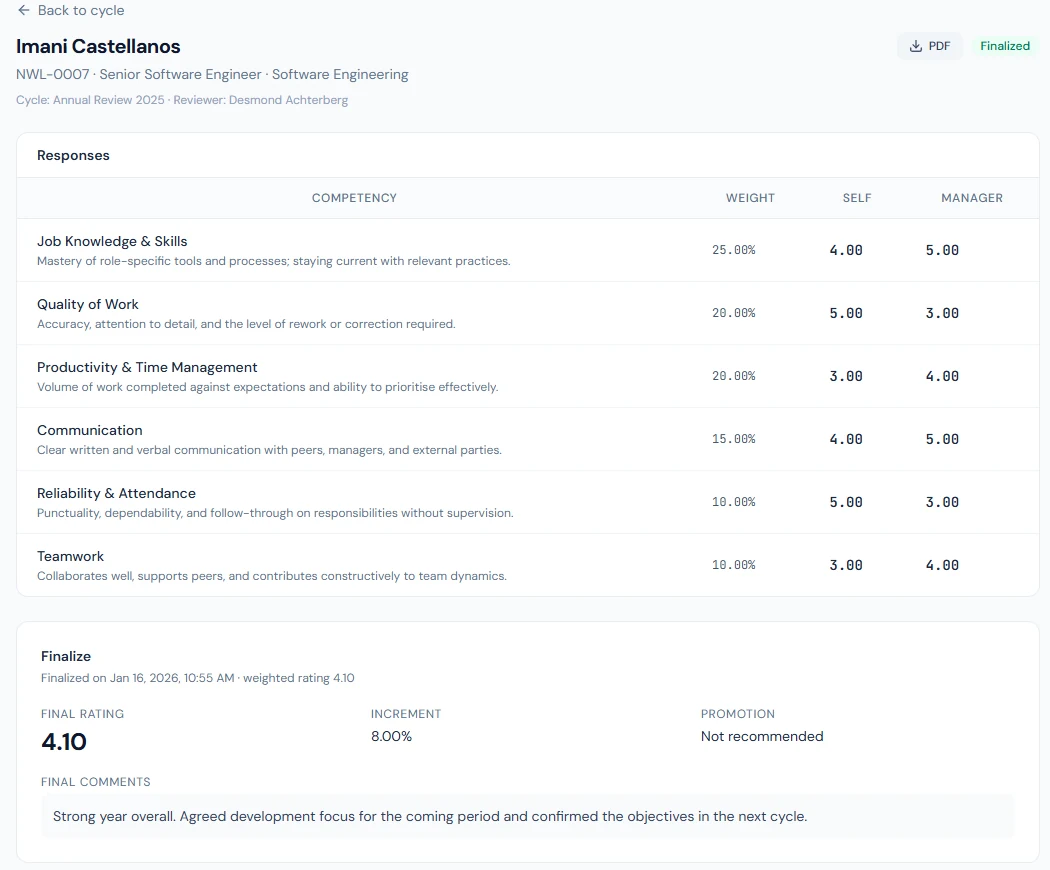
Imani Castellanos (NWL-0007), a Senior Software Engineer reviewed by Desmond Achterberg. Annual Review 2025: finalized at 4.10 on the five-point scale, "Exceeds expectations" territory, with a recommended increment of 8%. The raise: 5% from 20 January 2026, recorded as an annual merit increase (Chapter 57). The rating was an input, not a formula: the budget set the size, and the gap between 8% and 5% is exactly the kind of decision a calibration meeting should explain. Mid-Year Review 2026: finalized at 4.10 again. Between the two reviews, the merit ledger holds the evidence: the tasks Imani completed and how they were graded, the daily reports and their verdicts, the attendance days. A reviewer who opens that record before rating (Chapter 70) rates the half-year, not the last week.
What happens next
- Chapter 68 sets up appraisals, 69 runs a cycle, 70 reads the merit score, 71 to 74 are its sources, and 75 its settings and the increment recommendations.
What the employee sees
Their appraisals in the portal, with a self-review to write when a cycle opens and the finalized result and PDF afterwards; their own score, its sources and their badges; their tasks and daily reports.
Common mistakes
- Rating the last month. Open the record for the whole period first.
- A scale without descriptions. Every reviewer invents their own meaning of a 4; write what each point means.
- Weights that ignore the role. One template for engineers and sales staff weighs the wrong things for both.
- Skipping calibration. Strict and generous reviewers produce different raises for the same work.
- Treating the score as the review. It counts what can be counted; the review weighs the rest.
- Hiding the evidence from the employee. A rating that cannot be traced to work will be contested, and fairly.
Practice
Use your own trial workspace, not a customer's.
- Write a five-point scale for your team with one sentence per point.
- Pick three competencies for one role and weigh them to 100.
- List the evidence you would want in front of you before rating that role for a year, and mark which of it Operentra records.
Quiz
1. What is a periodic review good at, and weak at?
Good at judgement, weighing what no counter sees; weak at memory, because recent events crowd out the rest of the period.
2. What does continuous evidence add?
A dated record of work built up as it happens, so the review rates the whole period.
3. Why weigh competencies?
So the overall result reflects what matters most for the role.
4. What is calibration?
Comparing ratings across managers before they are final, so the same rating means the same thing in every team.
5. In Operentra, what are quality and volume?
Quality is points earned against points possible; volume is points earned against what the role expects. The score blends the two.