Chapter 44 — Leave fundamentals
Leave is the benefit employees count most carefully and the one HR systems get wrong most quietly: a balance that drifts, a weekend that was or was not consumed, a carry-forward that vanished in January. The rules are not complicated, but there are several of them and they compound. This chapter is the vocabulary, with Operentra's mapping of each term, before the next five chapters walk through the screens.
What this chapter covers
- 44.1 Entitlements, paid and unpaid leave, half days
- 44.2 Accrual, carry forward, encashment, negative balances
- 44.3 The sandwich rule
The concept
44.1 Entitlements, paid and unpaid leave, half days
An entitlement is a number of days of a particular kind of leave that a person may take in a period, usually a fiscal year: twenty days of annual leave, ten of sick leave, ninety of maternity. Each kind is a leave type, and the number, with the conditions around it, is the type's policy. Different staff can have different entitlements, which is what a leave group is for: a bundle of policies attached to a shift or a person.
Paid leave is paid as if worked; unpaid leave (leave without pay) is tracked for the record and deducted in payroll. A workspace needs the unpaid type as much as the paid ones, because the alternative to recording an unpaid day is an unexplained absence. Some leave sits between the two: paid at a reduced rate, such as half pay for part of a long sick leave where the law provides it.
A half day is the one fraction leave usually allows: a morning or an afternoon, charged as 0.5 against the balance. Smaller fractions are a regularization matter, not leave.
Entitlements also carry eligibility: a type reserved for one gender (maternity), a minimum service before it opens, and a pro-rata rule that scales the year's quota for someone who joined in August.
44.2 Accrual, carry forward, encashment, negative balances
Accrual is how an entitlement becomes available. Granting the whole year on the first day is simplest and most generous; releasing a twelfth each completed month protects the company from a person who takes twenty days in February and resigns in March. A third pattern, for residential or rotational staff, earns rest days from days worked: one day off for every twenty worked, rather than a yearly figure at all.
Carry forward decides what happens to unused days at year end: lost, or carried into the next year up to a cap. Encashment is the alternative to carrying: unused days paid out, usually at a day of the employee's own basic pay each, and usually only for the paid annual type. A negative balance lets someone borrow against days not yet accrued, up to a limit; it is a kindness to the person who needs a week in January on a monthly accrual, and a liability if they leave before earning it back.
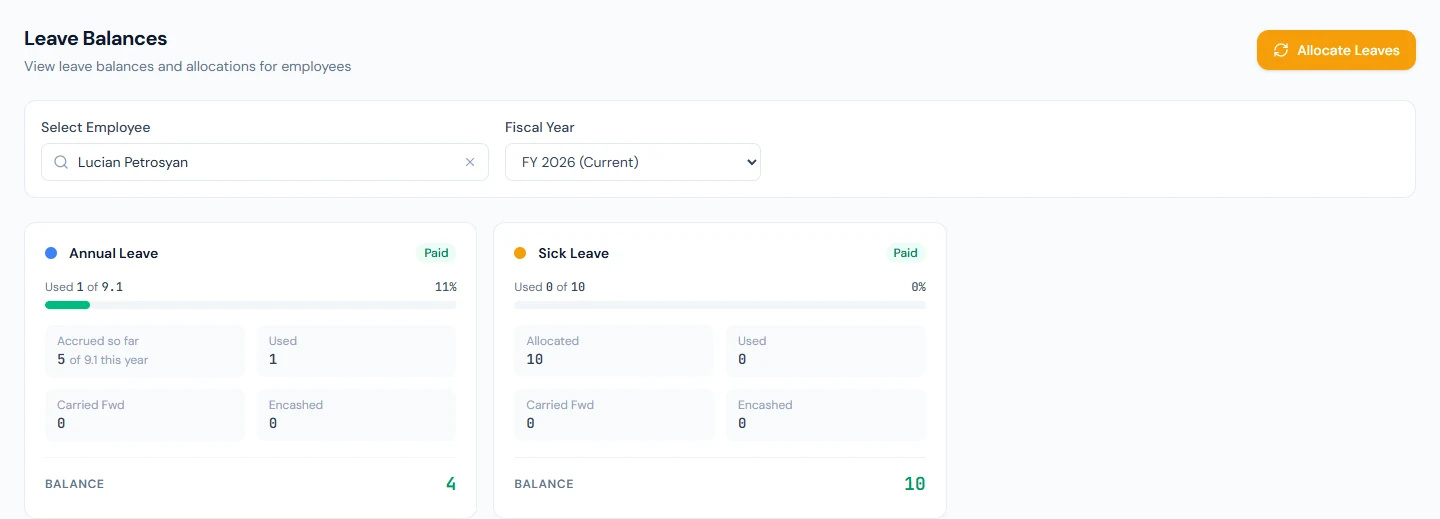
A balance is the running result: accrued plus carried forward, minus used, minus encashed.
44.3 The sandwich rule
A leave request from Friday to Monday is two working days or four calendar days, and policies differ on which to charge. The sandwich rule charges the rest days that are sandwiched: the weekend between a Friday and a Monday counts as leave because the person was, in effect, away for four days. A stricter variant charges rest days adjacent to a leave day as well, so that a Monday alone consumes the Sunday before it, or the whole connected run of weekend and holiday. The rule exists to stop the four-day weekend that costs one day of leave, and it should be published, because it is the single most-disputed line in any leave policy.
Without any sandwich rule, a request consumes only the working days inside it; weekends and holidays in the range are skipped.
How Operentra handles it
- Leave types (Chapter 45) are the kinds: a name, a code, a colour, whether paid, and for a paid type the share of a day's pay it pays (100% unless set lower). Northwind's six are Annual, Sick, Maternity, Parental, Bereavement and Leave Without Pay.
- A policy per type holds the entitlement and every rule above: annual quota, maximum consecutive days, carry forward and its cap, encashment with its basis and rate (days of basic pay, or a fixed amount per day), negative balance and its limit, gender, minimum service months, pro-rata for joiners, a document required after N days, the accrual method (annual, monthly or quarterly), the two sandwich rules, and an effective period.
- Two accrual modes: annual quota (credited at the fiscal year's allocation, released all at once or a twelfth per completed month) and cyclic accrual (a daily job counts days worked and credits the cycle's days, up to a cap).
- Leave groups (Chapter 46) bundle policies; the group that applies to a person is their own, else their shift's, else the company default.
- Allocation (Chapter 47) writes each employee's balances for the fiscal year, applying pro-rata, eligibility and carry forward; a nightly job does it at the fiscal year's start.
- Applications (Chapter 48) are checked against the policy on submission: eligibility, the maximum consecutive days, the balance (or the negative limit), the document requirement, and the sandwich rules in the day count; half days are a tick on the form.
- Encashment (Chapter 49) pays unused days at the policy's rate: a multiple of the employee's daily basic pay, or a fixed amount per day.
- Who:
leave.configure(Super Admin, HR Manager) sets all of this;leave.applyis every role.
Walkthrough
Northwind's six types are set up as a US small company might: Annual Leave with twenty days, released a twelfth a month, up to twenty in one stretch, five carried forward, encashable, no negative balance, pro-rata for joiners; Sick Leave with ten days and a document after two; Maternity with ninety for female employees; Parental with ten; Bereavement with three; and Leave Without Pay, unpaid, open-ended. No sandwich rule is on, so a Friday-to-Monday request costs two days. The chapters that follow open each of those screens; this one reads two cases with the vocabulary.
A joiner in August
An employee who joined on 1 August on the Annual policy is allocated pro-rata, five twelfths of twenty, and sees it released a twelfth a month, so by October their available annual leave is small and exactly explainable. Their sick leave, on the annual method, is all ten from the first day: the seeded Sick Leave policy has pro-rata for joiners switched off, so a joiner gets the full quota at once. Switch it on in the policy (Chapter 45) to prorate sick leave too.
A Friday-to-Monday request
With no sandwich rule, the request consumes two days, Friday and Monday. With the between rule on, it consumes four. With the adjacent rule on at immediate scope, a Monday alone consumes two (Sunday and Monday); at all scope, three when Saturday is also a rest day, and more when a holiday touches the run.
What happens next
- Payroll reads approved leave: paid days as worked, days of a reduced-pay type at its share, unpaid days as deductions (Chapter 54).
- The year end rolls balances by the carry-forward rules and re-allocates (Chapter 47).
What the employee sees
Their balances per type in the portal, the apply form with the day count the rules produce, and the result of each request (Chapter 48).
Common mistakes
- Granting the whole year up front to everyone. Monthly release exists for the February problem; choose per type.
- Carrying forward without a cap. Balances grow for years; set the cap the policy means.
- Turning on the sandwich rule without telling anyone. It changes the day count of a request already in people's heads.
- Forgetting the unpaid type. Without it, an unpaid day is an absence with no record.
- Pro-rata off for a company that hires all year. August joiners get a full year.
- A document rule of zero. Zero means never; set the number of days after which a note is needed.
- Encashment on sick leave. It is for the paid annual type; the rate pays real money for every day encashed.
- Negative balances without a limit. The limit is what makes the kindness safe.
Practice
Use your own trial workspace, not a customer's.
- Write your company's leave policy in one paragraph per type: quota, accrual, carry forward, encashment, negative, eligibility, sandwich.
- Open Leave Types and Leave Policies and compare each starter policy with your paragraph.
- Calculate by hand the annual leave available in October to someone who joined on 1 August on a twenty-day monthly-release policy with pro-rata on; then read it on their balances page.
- Decide, and write down, whether your company charges sandwiched weekends.
- List which of your types should be encashable and at what rate.
Quiz
1. What is the difference between an entitlement and a balance?
The entitlement is the policy's number of days for the period; the balance is what remains, accrued plus carried forward minus used and encashed.
2. What does monthly accrual change?
The quota is released a twelfth per completed month of service in the fiscal year rather than all at once, so an early resignation cannot take a year's leave in its first weeks.
3. What is cyclic accrual for?
Staff who earn rest from days worked, such as residential or rotational workers: a fixed number of leave days is credited for every block of worked days, up to a cap.
4. How does the sandwich rule change a Friday-to-Monday request?
Without it, two days; with the between rule, four, because the weekend between two leave days counts as leave.
5. Which three places can a person's leave group come from?
Their own assignment, their shift's default group, or the company's default group, in that order.