Chapter 25 — Recruitment fundamentals
Part 5 is about hiring: the work that happens before an employee record exists. Operentra's recruitment module (Chapters 26 to 30) is a tool for that work, and like every tool it rewards people who know what they are doing with it. This chapter is the craft: four decisions every hire turns on, what good practice looks like for each, and the words Operentra uses for them so the next five chapters read easily.
What this chapter covers
- 25.1 Requisitions and job descriptions
- 25.2 Sourcing channels
- 25.3 Structured, fair interviews
- 25.4 Making and negotiating offers
The concept
Hiring is a funnel with a decision at every narrowing: whether to hire at all, where to look, whom to interview, whom to offer, and on what terms. Each decision is cheaper to get right than to undo. A badly scoped requisition produces a hundred wrong applicants; a vague interview produces a confident wrong hire; a late offer loses the right one to someone faster. The four sections below are those decisions in order.
Two threads run through all four.
Write it down before you act on it. The role before the advert, the questions before the interview, the terms before the call. Writing forces the decision; it also leaves the trail that fairness and the law depend on.
Compare people against the role, not against each other on the day. The candidate who interviewed on a good morning should not beat the one who had a worse slot. Structure, scorecards and a written standard are how you keep the comparison honest.
25.1 Requisitions and job descriptions
A requisition is the internal decision to hire: which role, how many, in which team, at what level, approved by whom. It exists before anyone outside the company knows, and it is where the budget conversation happens. Operentra calls this a job opening, with a headcount, a department, a designation, an employment type and an internal notes field for exactly that conversation (Chapter 26). An opening starts as a draft and is moved to Open when it is approved; nothing can be published or applied to before then.
A job description is what the outside world sees. It has four jobs: tell the right person this is for them, tell the wrong person early that it is not, set expectations that the interview can test, and give the hire a reference for their first months. The structure that does all four:
| Section | What it answers | What goes wrong |
|---|---|---|
| About the role | What this person is for, in two or three sentences | A paragraph of company history and nothing about the job |
| What you'll do | The five to eight things that fill a typical week | A wish list of twenty, none of which is the main one |
| What we're looking for | What is required, and separately what is nice to have | Years-of-experience thresholds that filter out the people who would be best at it |
| Benefits and terms | Location, remote policy, employment type, salary range where you show it | Silence on pay, which costs you the candidates who will not apply blind |
Operentra's posting form has these four sections, plus location, a remote policy and a salary range with a switch for whether the range is public. Write the role in the second person and the present tense; cut anything that could appear under any job at any company.
On the salary range: show it where you can. A visible range filters better than any other line in the advert, and several jurisdictions now require it. Where you cannot, decide the range anyway and keep it in the opening's internal notes, because the offer in 25.4 will need it.
25.2 Sourcing channels
Candidates come from somewhere, and knowing where tells you where to spend next time. The usual channels, with what each is good for:
- Your own careers page. Free, always on, and the place every other channel ends up linking to. Operentra gives every workspace one (Chapter 27), with a page per open role that search engines can list.
- Job boards and social networks. Volume. A LinkedIn post or an Indeed listing points at your careers page; the application still lands in the same place.
- Referrals. The best hit rate in most companies and the cheapest. Tell people what you are hiring for, and record who referred whom so the thank-you is not forgotten.
- Agencies and headhunters. Expensive, fast, and right for senior or scarce roles. Track them separately so the fee is visible against the outcome.
- Direct approach. Somebody you found and wrote to. Slow, precise, and the only way to reach people who are not looking.
Whatever the channel, track the source on the application. In Operentra every application carries one: careers page by default for anyone who applied through the site, and a source you pick (LinkedIn, referral, headhunter, direct email, manual entry, other) with a free detail line when HR adds the candidate by hand (Chapter 28). Six months of that field answers "where do our good hires come from" without a spreadsheet.
Two sourcing rules that save embarrassment. One candidate, one record: the same person applying to three roles is one person with three applications, not three strangers, and Operentra matches on the email address to keep it so. And never collect what you will not use: a form that asks for a photo, a date of birth or marital status is collecting grounds for a discrimination claim, not information.
25.3 Structured, fair interviews
An interview is a measurement, and measurements are only comparable when they are taken the same way. A structured interview means:
- The same rounds for everyone applying to the role: a screening call, a skills conversation, a panel with the team, a final with the hiring manager. Decide the rounds when the opening is approved, not candidate by candidate.
- The same core questions in each round, written in advance and tied to the job description. Follow-ups can vary; the backbone does not.
- A scorecard filled in straight after, before anyone talks to anyone. A rating, a recommendation, and the evidence behind it: what the candidate said or did that earned the score. Operentra's interview feedback is exactly this shape: a 1 to 5 rating, a recommendation from strong no to strong yes, optional per-competency scores, and strengths, concerns and notes (Chapter 29).
- A panel decision made from the scorecards, where the most senior person speaks last.
Fairness is mostly the same list seen from the candidate's side, plus some things the interviewers must not do. Do not ask about age, family plans, health, religion, nationality or anything else unrelated to the work; in most places those questions are illegal, and in all places they are useless. Do not let one interviewer's strong voice become the panel's view. Do not compare a candidate to the last person in the chair instead of to the standard. And keep the record: who interviewed whom, when, what was scored and why, so that a decision can be explained a year later.
Logistics are part of fairness too. A candidate who is told the time, the place, who they will meet and how long it takes performs as themselves; one who is kept guessing performs as a nervous version. Operentra sends the invitation with a calendar file, lets the candidate confirm or ask to reschedule from a link, and reminds both sides the day before (Chapter 29).
25.4 Making and negotiating offers
By the time you make an offer you have spent weeks and the candidate has spent evenings. Everything that goes wrong here is expensive, and most of it is avoidable.
Decide before you call. The salary, the joining date, what is negotiable and what is not, and by when you need an answer. The range in the opening's notes (25.1) is the ceiling; an offer made above it is a budget conversation you have skipped.
Make it in writing, fast. A verbal offer followed by a letter days later is a window for the other company. In Operentra the offer is a record with a monthly salary, a joining date and an expiry date; it goes to the candidate as an email with the offer letter attached and a link to accept or decline online (Chapter 30). The expiry date is the answer to "by when": a reasonable one is a week; an open-ended offer is a negotiation you have agreed to in advance.
Negotiate once. Ask what would make them say yes, decide, and answer. A second round of haggling signals that the first number was not real. If you cannot move on salary, move on something else: the joining date, a review at six months, a title.
Read a decline. Operentra asks a candidate who declines for a reason and passes it to the hiring team. "Compensation" three times in a row is the market telling you the range is wrong; "timing" is a process telling you the offer came too late.
Close the loop. The candidates you did not choose get a rejection with a reason the day you decide, not when the hire starts. Operentra makes the reason mandatory and emails it (Chapter 28), because a candidate who hears nothing tells people, and the next role you post will be read by them.
Where this lives in Operentra
| Practice | Operentra |
|---|---|
| Requisition | Job opening: title, department, designation, employment type, headcount, internal notes; Draft until approved, then Open (Chapter 26) |
| Job description | The opening's Posting tab: description, what you'll do, what we're looking for, benefits, location, remote policy, salary range and its visibility switch (Chapter 26) |
| Careers page | A public, search-engine-ready site with a page per open role and an apply form (Chapter 27) |
| Sourcing | The source on every application; candidates added by hand carry the channel you choose (Chapter 28) |
| Structured interviews | Rounds, interviewers, branch or meeting link, candidate confirmation, reminders, scorecards from the panel (Chapter 29) |
| Offers | Salary, joining and expiry dates, offer letter PDF, accept or decline online with a reason (Chapter 30) |
| Hiring | Convert to employee, which opens the Add Employee form pre-filled and starts onboarding (Chapter 30, Chapter 16) |
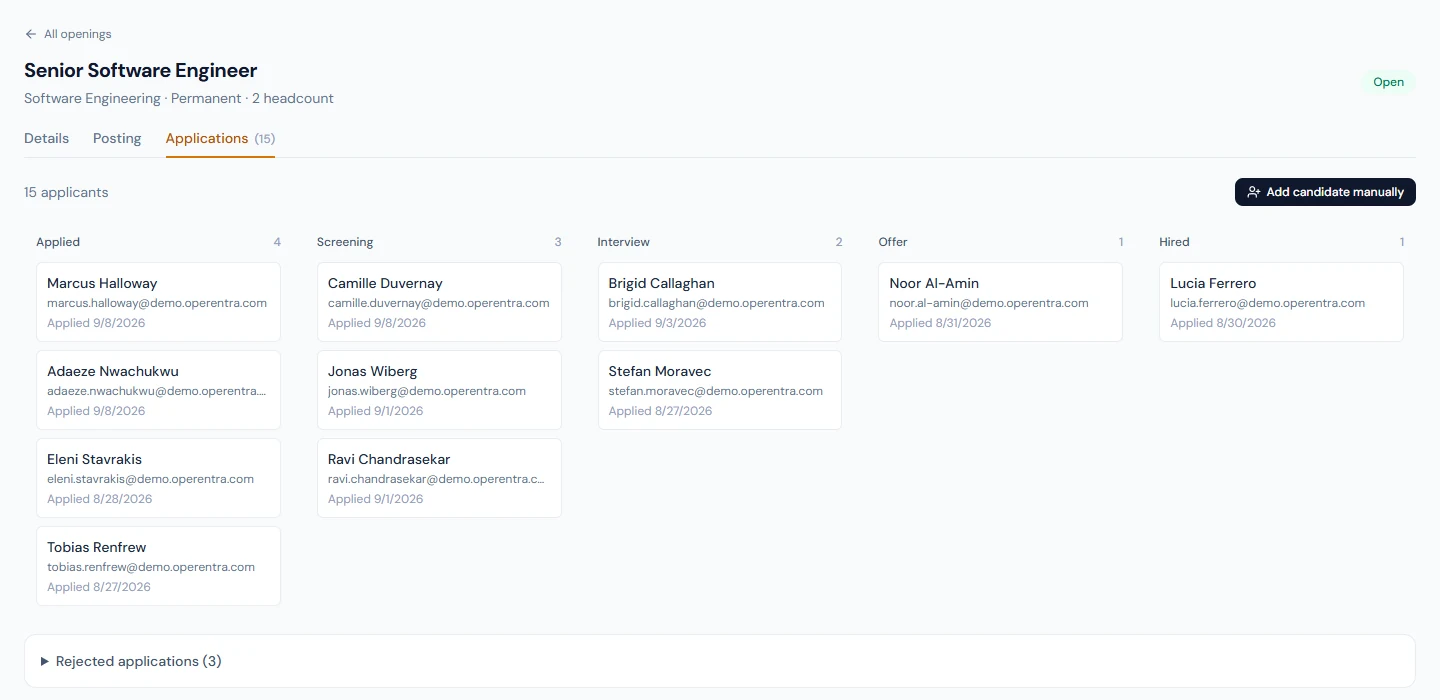
Access to all of it is behind three permissions: view, manage and interview. A new workspace grants them to the Super Admin only; if your HR Manager runs hiring, give the role those permissions on Users and Roles (Chapter 14). Panel members do not need any of them to see their own interviews and submit feedback from the portal.
Common mistakes
- Posting before the requisition is approved. The advert draws applicants for a role that may not be funded; Operentra will not publish a draft opening for this reason.
- A job description written from the org chart. Reporting lines and company history instead of what the person will do.
- Hiding the salary and then losing candidates at offer. The range should be settled before the posting, even when it is not shown.
- Interviewing without a written question set. Every candidate gets a different interview and the scores mean nothing.
- Discussing the candidate before the scorecards are in. The panel converges on the loudest view.
- Asking questions you cannot act on. Age, family, health, origin: unlawful in most places and irrelevant everywhere.
- A verbal offer with the letter to follow. The letter is the offer; make it the same day, with an expiry.
- Rejecting by silence. The candidate who never hears back is the one who warns the next ten.
Practice
No workspace needed for this chapter.
- Take a role your organisation hires often and write its requisition in five lines: title, team, level, headcount, the reason it exists.
- Rewrite its job description into the four sections in 25.1. Cut every sentence that could appear under any job anywhere.
- List the channels the last five hires came from. If you cannot, that is the finding: start recording the source.
- Draft the core questions for a thirty-minute screening call for that role, six at most, each tied to a line in the description.
- Write the offer rules for the role before the next interview: range, what is negotiable, the standard expiry.
Quiz
1. What is the difference between a requisition and a job description?
The requisition is the internal decision to hire: role, headcount, team, level, approval. The job description is what candidates see. In Operentra they are the opening and its posting, and the posting cannot be published until the opening is approved (Open).
2. Why record the source on every application?
So that, over time, you know which channels produce the hires you keep and which produce volume you reject. It is also how referrals get thanked and agency fees get judged.
3. Name three things that make an interview structured.
The same rounds for every candidate, the same core questions written in advance, and a scorecard with a rating, a recommendation and the evidence, filled in before the panel talks.
4. What belongs in an offer, and why does the expiry date matter?
The salary, the joining date, what is and is not negotiable, in writing, the same day. The expiry date turns "think about it" into a decision by a date and stops an open-ended negotiation.
5. Who holds the recruitment permissions in a new Operentra workspace?
Only the Super Admin. Give them to the HR Manager role, or whichever role runs hiring, on Users and Roles. Interviewers need none of them to see their own interviews in the portal.