Chapter 1 — What HR does
Human resources is the part of a company that looks after the people in it: finding them, hiring them, paying them, keeping their records, handling their time off, and making sure the company meets its obligations as an employer. In a company of five people the founder does it in spare moments. At forty-five people it is a job, and the question is whether it is done well.
This chapter maps the territory. Nothing in it needs a screen yet.
What this chapter covers
- 1.1 The five functions of HR
- 1.2 The employee lifecycle
- 1.3 HR as the custodian of employee data
- 1.4 Confidentiality, ethics and fairness
- 1.5 How this course follows the lifecycle
1.1 The five functions of HR
HR work falls into five functions. A small company may have one person doing all five; a large one has a team for each. Knowing which function a task belongs to tells you who should do it, what it depends on, and what can go wrong.
People operations is the day-to-day administration of employment: the employee record, contracts, attendance, leave, transfers and promotions, letters, and the questions employees bring to HR. It is the function that keeps everything else accurate.
Payroll turns a month of employment into money: salary, the days docked for absence, bonuses and reimbursements, loans, tax withheld, contributions to social security and pension funds, and the file sent to the bank. Payroll is the most unforgiving function. An error here is an error in someone's rent.
Talent brings people in and helps them grow: job openings, candidates, interviews, offers, onboarding, performance reviews, and the increments and promotions that follow. It is the function with the longest feedback loop; a bad hire shows up months later.
Employee relations covers the relationship between the company and its staff: policies, grievances, discipline, communication, and the exit when it comes. Much of it is judgement rather than process, which is why the record-keeping around it matters so much.
Compliance is the obligations the company has as an employer: written contracts where the law requires them, working-time limits, statutory leave, tax and social-security filings, and keeping the records a regulator can ask for. Compliance is not a separate activity; it is a property of the other four functions done correctly. Chapter 3 is about it.
At Northwind Labs, the fictional Austin software company the course uses as its example, Dana Whitfield runs HR for about 45 people. On a typical Monday Dana approves two leave requests (people operations), checks the September payroll that finance queued for review (payroll), schedules an interview for an open engineering role (talent), answers a question about the parental leave policy (employee relations), and files a new hire's tax form (compliance). Five functions before lunch.
| Function | Typical work | In Operentra |
|---|---|---|
| People operations | Employee records, contracts, attendance, leave, transfers, letters | Employees, Contracts, Attendance, Leave, HR Letters |
| Payroll | Salary structures, monthly runs, deductions, payslips, bank files | Payroll, Loans, Expense claims, Reports |
| Talent | Job openings, candidates, interviews, offers, onboarding, appraisals | Recruitment, Onboarding, Performance |
| Employee relations | Policies, announcements, grievances, exits | Announcements, Offboarding, the employee portal |
| Compliance | Statutory rules, filings, record keeping | Country packs, Statutory coverage, Audit logs, Documents |
1.2 The employee lifecycle
Every employee moves through the same stages, and almost every HR task belongs to one of them:
Attract → Hire → Onboard → Manage → Pay → Develop → Exit
- Attract. The company describes a role and puts it where candidates will see it: a careers page, job boards, referrals.
- Hire. Candidates are screened, interviewed and compared; one gets an offer; the offer is accepted.
- Onboard. The new hire becomes an employee: a contract is signed, a record is created, equipment is issued, accounts are set up, and the first weeks are planned.
- Manage. The long middle. Attendance is recorded, leave is taken and approved, the employee's details change, they move between teams and branches.
- Pay. Every month the record of what happened becomes a payslip and a bank transfer, with tax and contributions handled correctly.
- Develop. Performance is reviewed, goals are set, pay is adjusted, promotions happen.
- Exit. The employee resigns or is let go; notice is served; company property comes back; the final settlement is paid; the record is closed and kept for as long as the law requires.
The stages are not independent. The job description written at attract becomes a clause in the contract at onboard. The hours recorded at manage decide the pay at pay. The appraisal at develop justifies the increment that changes the next payslip. The leave balance built up over years is paid out at exit. HR software exists largely so that data entered once at one stage is correct at every later one.
1.3 HR as the custodian of employee data
Of all the records a company keeps, the employee record is the one most other records depend on. A typical one holds:
- Identity: legal name, date of birth, nationality, a national ID or tax number, a photo.
- Contact: addresses, phone numbers, personal and work email, an emergency contact.
- Employment: employee code, department, designation, branch, employment type, joining date, probation and confirmation dates, reporting manager.
- Pay: salary, bank account, tax and social-security registrations.
- Documents: the contract, ID copies, qualifications, visas or permits where they apply.
- History: transfers, promotions, salary changes, leave, attendance, appraisals, letters issued, and eventually the separation.
Payroll reads the pay details. Contracts and letters read the identity and employment details. Tax filings read the registrations. Approvals follow the reporting manager. One wrong field (a stale bank account, a misspelt legal name, a joining date a month off) propagates into every document built from it.
Two habits keep the record clean. First, one source of truth: the HR system holds the record, and spreadsheets, if they exist at all, are exports from it, never the other way round. Second, employees maintain their own details, with HR approving the change. The employee knows their new address before HR does; HR knows whether the change needs a document to back it. Operentra works this way: employees edit their profile in the portal, and the change waits in Profile change approvals until HR accepts it.
1.4 Confidentiality, ethics and fairness
HR sees what nobody else in the company should: salaries, medical reasons for leave, disciplinary history, home addresses, bank details. Three principles follow.
Need to know. Access to employee data goes to the people who need it for their job, and no further. A department head needs their team's attendance and leave; they do not need the team's salaries. An accountant needs the payroll figures; they do not need the disciplinary file. In Operentra this is a matter of roles and permissions: each role grants a set of permissions, each user holds one or more roles, and a manager's view is scoped to their own direct reports. Chapter 14 sets it up.
Consistency. The same policy applies to everyone in the same situation. Fairness in HR is less about generosity than about predictability: if the leave policy says unpaid leave needs manager approval, it needs it for the CEO's assistant too. Software helps because it applies the rule without being asked.
A record of decisions. When HR approves, rejects, changes or deletes something, the decision should be traceable: who did it, when, and from what. That protects employees from arbitrary treatment and protects HR when a decision is questioned later. Operentra keeps an audit log of changes and records who approved each request. It also refuses to let someone decide their own request (their own leave, expense claim or loan) while another approver exists, which removes the most common conflict of interest before it happens.
1.5 How this course follows the lifecycle
The course is arranged in the order a new HR person meets the work:
| Part | What you learn | Lifecycle stage |
|---|---|---|
| 1 | HR foundations (this part) | — |
| 2–3 | Your workspace, your organisation, users and roles | Set-up |
| 4 | Employee records | Onboard, Manage |
| 5–6 | Hiring, contracts, onboarding, assets | Attract, Hire, Onboard |
| 7–8 | Time, attendance and leave | Manage |
| 9–10 | Payroll, loans, expenses | Pay |
| 11 | Performance, tasks, reports | Develop |
| 12 | Letters, documents, announcements, email | Manage |
| 13 | Exits and final settlement | Exit |
| 14 | The employee portal, as your employees see it | All |
| 15–17 | Reports, audit, data protection, billing, integrations | All |
| 18 | Capstone: a year at Northwind Labs, and the assessment | All |
Part 1 gives you the vocabulary (Chapter 2) and the obligations (Chapter 3). From Part 2 onward every chapter is hands-on.
Where this lives in Operentra
Operentra is one workspace per company, with two faces:
- The admin panel is where HR, finance and managers work. Each HR function above is a group of modules in its sidebar.
- The employee portal is where every employee sees their own attendance, leave, payslips, documents and requests, and where managers approve what their team submits.
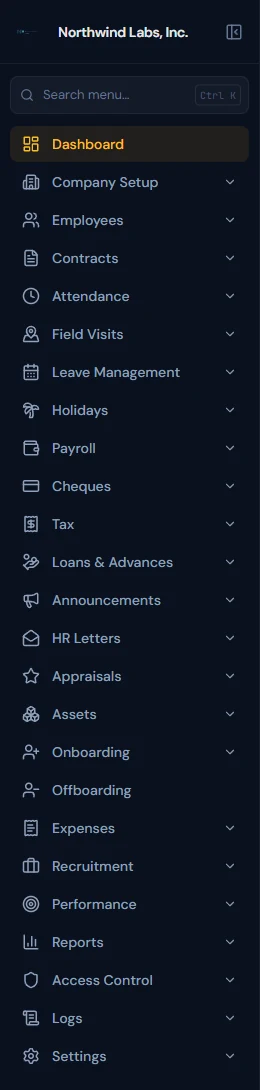
A workspace starts with a standard set of roles — super admin, HR manager, HR officer, accountant, department head and employee — which you can change or add to. Chapter 5 is the tour.
Common mistakes
- Treating HR as paperwork. The paperwork is the output. The job is keeping the company's obligations to its people, and theirs to the company, in order.
- Letting the record drift. Three spreadsheets and an email thread are three versions of the truth. Pick the system and make everything else an export.
- Giving everyone admin access because it is quicker. It is, until the first salary leaks.
- Approving your own request or a friend's, because it was easier than waiting. The habit, not the one case, is the problem.
- Finding out about a rule from the penalty. Compliance is cheaper read than discovered. Chapter 3 is the reading.
Practice
No workspace yet; a notebook will do.
- Take a company you know, yours or a former employer's. List ten HR tasks you have seen done there and sort each one into the five functions.
- Pick one employee's journey through that company and write the seven lifecycle stages with one real event under each. Note where data from an earlier stage was needed at a later one.
- From the employee-record list in 1.3, mark which fields a department head should see, which an accountant should see, and which only HR should see. You will build exactly this in Chapter 14.
Quiz
1. Which HR function does "sending the monthly bank file" belong to?
Answer
Payroll. It is the last step of turning a month of employment into money.
2. The job description written when a role is advertised ends up in which later document?
Answer
The employment contract, at the onboarding stage. In Operentra the designation's job description flows into the employment agreement.
3. Why should employees update their own contact details rather than HR?
Answer
They know the change first and get it right; HR's job is to approve it and check whether a document is needed. Operentra holds the change in Profile change approvals until HR accepts it.
4. A department head asks for access to their team's salaries "to plan the budget". What principle applies?
Answer
Need to know. Budget planning is finance's job with aggregated figures; the head's role does not require individual salaries. Give the head what their role needs, nothing more.
5. What makes compliance different from the other four functions?
Answer
It is not a separate activity. It is the other four done correctly, against the rules of the country the company operates in.