Chapter 60A — Recurring deductions and garnishments
A court orders child support taken from an employee's wages. A union member asks for dues to come out of pay. A health plan's premium is the employee's share each month; a savings scheme takes a fixed sum until a target is reached. None of these is a loan, because the company advanced nothing; none is a one-off, because they recur. Done by hand they are an adjustment typed every month, missed in the month HR is away, and taken in full in a month when pay was short and the law said it should not be. This chapter records each one once and lets payroll do the rest.
What this chapter covers
- 60A.1 What a recurring deduction is
- 60A.2 Recording one: kind, amount, dates, cap, priority
- 60A.3 The protected share of pay
- 60A.4 How payroll takes it: claim, settle, complete
- 60A.5 Pausing, cancelling and the slip
- 60A.6 The monthly register
The concept
A recurring deduction is a standing instruction against pay: so much a month, or such a share of net pay, from a start month until an end month or until a total has been reached. A garnishment (an attachment of earnings) is the kind a court or an agency orders, and the law in most countries says how much of a person's pay it may reach: a share of net pay is protected and must reach the employee whatever the order says. When several deductions compete for too little pay, the order of the law applies: a court order first, then the rest. What cannot be taken in a month is not a debt the employer carries forward; the order names a monthly figure, and the next month is judged on its own.
How Operentra handles it
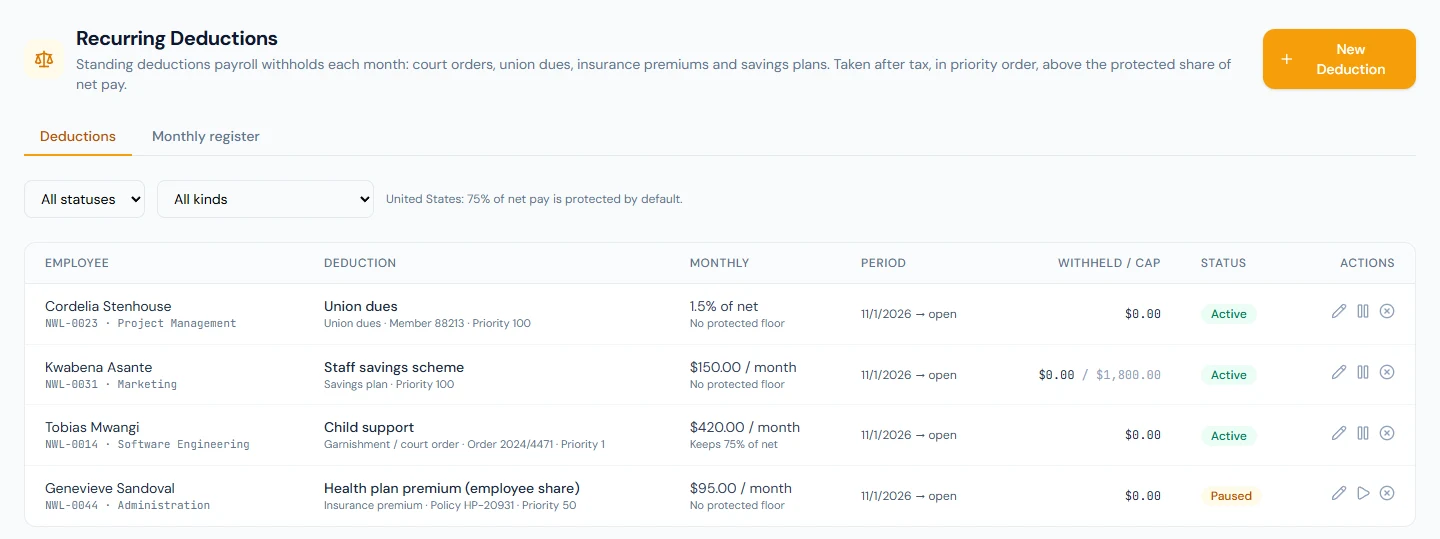
- Payroll › Recurring Deductions records each one: the employee, the kind, the name as it prints on the slip, the reference, a fixed amount or a share of net pay, the months it runs, a cap on the total, a priority, and the protected share of pay.
- The country pack supplies the protected share where the statute fixes one; elsewhere HR enters the order's own figure, or none.
- Payroll takes recurring deductions after income tax, the statutory contributions, loan instalments, the attendance docks and the month's adjustments, from what is left, in priority order, never below the protected share, and never past the cap.
- Locking the run settles the month: paid to date moves, and a deduction that reached its cap completes itself.
- Pause skips months; Cancel stops it from the next run.
- The slip prints one line per deduction under its name and reference; the register lists a month for finance, with a CSV.
- Who:
payroll.salary_view_allto read (Super Admin, HR Manager, Accountant);payroll.manageto record, edit, pause and cancel. Employees see their own on their slip.
Walkthrough
Northwind has four this month. Tobias Mwangi (NWL-0014) has a child-support order: a fixed sum each month, priority 1, with the pack's protected share. Cordelia Stenhouse (NWL-0023) pays union dues of 1.5% of net pay. Kwabena Asante (NWL-0031) saves a fixed sum a month into the staff scheme until a target is reached. Genevieve Sandoval (NWL-0044) has a health premium on pause while her cover is reviewed.
60A.1 What a recurring deduction is
A deduction is one of five kinds: a garnishment or court order, union dues, an insurance premium, a savings plan, or other. The kind sets the default priority (a garnishment runs first) and tells the accountant what the money was; the name is what the employee reads on the slip ("Child support"), and the reference is the order, policy or membership number beside it. A deduction belongs to one employee and prints on that employee's slip only.
60A.2 Recording one: kind, amount, dates, cap, priority
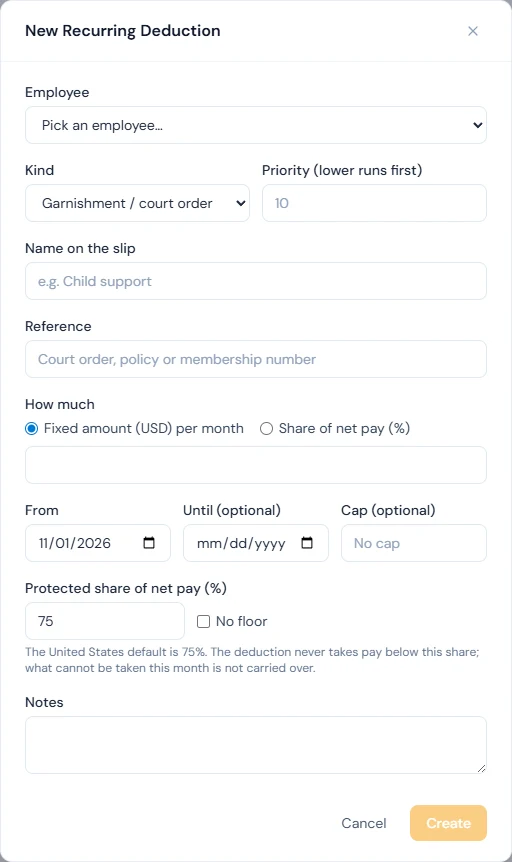
Payroll › Recurring Deductions › New Deduction asks for the employee and the kind, the name and reference, and how much: a fixed amount in the workspace currency per month, or a share of net pay as a percentage. From is the first month it applies; Until is optional; a cap is the most to withhold over its life, for a savings target or an order with a total. Priority decides the order when pay is short: lower runs first, a court order at 10 and the rest at 100 unless HR says otherwise. Tobias's order is a fixed sum from this month with no end and no cap, priority 1; Kwabena's savings plan is a fixed sum with a cap and runs until the cap is reached.
An order often comes as a document. Upload it to the employee's documents (Chapter 22) and name it on the deduction, so the reviewer of the slip can read what the deduction rests on.
60A.3 The protected share of pay
The protected share is the percentage of net pay, after tax, that must reach the employee whatever the deductions say. The country pack offers its statute's figure: 60% in the United Kingdom and New Zealand, 75% in the United States, 50% in India and Singapore. Where the law publishes amount tables or varies by province or order (Germany, France, Australia, Canada), or says nothing, the pack offers no figure and HR enters the order's own, or ticks No floor for a deduction the employee asked for themselves. The form shows the pack's default and the deduction keeps its own copy, so an order that names a different share is recorded as it reads.
The share is worked out on what is left after tax, the statutory contributions, loan instalments, the attendance docks and the month's adjustments, before any recurring deduction, and each deduction's floor is its own: union dues with no floor are not held back by the court order's.
60A.4 How payroll takes it: claim, settle, complete
When the month is processed, the engine takes each deduction in priority order from the disposable figure of §60A.3: the fixed amount or the share, no more than the cap still allows, and no more than the room above the protected floor. Tobias's order and the dues both fit in a normal month. In a month of unpaid leave, the order takes what the floor leaves and the dues may take nothing; neither shortfall is carried to the next month. The run page's breakdown and the slip show each line.
As with a loan instalment (Chapter 60), processing only claims the month. Locking the run (or paying it, which locks it first) settles it: paid to date moves, and a deduction whose cap is now reached becomes Completed. Reprocessing a run before it locks releases the month and takes it again from the deduction's current state. When Kwabena's savings reach the cap, the run that takes the last sum completes the plan, and the last sum is only what the cap still needed. The cap counts what is claimed as well as what is settled: if March's run is still in review when April is processed, April takes only what March's claim leaves under the cap, never the same room twice.
60A.5 Pausing, cancelling and the slip
Pause skips every month until Resume; nothing is owed for the months skipped. Genevieve's premium is paused while her cover is reviewed and resumes when it is settled. Cancel ends a deduction from the next run and keeps what earlier runs withheld; a cancelled or completed deduction can no longer be edited. The dates, amount, cap, priority and protected share of an active or paused one can be edited, and the cap can never be set below what is already paid.
On the slip, each deduction prints under its own name and reference, so the employee reads "Child support (order 2024/4471)" and not a total. The portal's salary page lists the same lines.
60A.6 The monthly register
Payroll › Recurring Deductions › Monthly register lists, for a month, every deduction in force: the employee, the deduction, the monthly figure, what the run withheld (blank until the month is processed, "claimed" until it is locked), paid to date, the cap and what remains of it. Export CSV gives finance the month's remittances: what to send to the court, the union and the insurer.
What happens next
- Payroll (Chapters 55 and 58) takes the lines with the month's salary; in the accounting journal (Chapter 95) they fall under the deductions line.
- Reports: the register for a month; the payroll CSV carries each person's monthly total.
What the employee sees
Each deduction on their slip and on the portal's salary page, under its name and reference, in the month it was taken; nothing of the protected share or the priority, which are HR's to set.
Common mistakes
- Entering a court order as an adjustment every month. It is forgotten in the month HR is away and taken in full in a month pay was short. Record it once.
- Entering it as a loan. A loan writes a schedule of instalments and a balance the employee owes; an order has neither.
- Setting no floor on a garnishment. The statute's share must reach the employee; leave the pack's figure unless the order names its own.
- Expecting a shortfall to be carried forward. What the floor kept back in one month is not taken in the next; an order names a monthly figure.
- Cancelling instead of pausing. A pause skips months and keeps the record; a cancelled deduction is closed for good.
- Reading paid to date before the run is locked. A processed but unlocked month is claimed, not paid; lock the run and it moves.
Practice
Use your own trial workspace, not a customer's.
- Record a garnishment with a fixed amount, priority 1 and the pack's protected share; record union dues of 1% of net pay for the same person with no floor.
- Process the month, open the run and read the two lines; open the employee's slip.
- Give the person a long unpaid leave in a copy month, process it, and read how the floor limited the order.
- Record a savings plan with a cap of three months' sums, lock three runs, and watch it complete.
- Pause a deduction, process a month, resume it, and compare the register for the two months. Export the CSV.
Quiz
1. Why is a court order not entered as a loan or an adjustment?
The company advanced nothing, so there is no balance to repay as a loan; and it recurs every month with a priority and a protected share, which a one-off adjustment has no way to say.
2. From what figure is a recurring deduction taken?
What is left after income tax, the statutory contributions, loan instalments, the attendance docks and the month's adjustments; the protected share and a share-of-net figure are both worked out on it, before any recurring deduction.
3. Pay is short and the floor leaves room for only part of a court order. What happens to the rest?
It is not taken and not carried forward; an order names a monthly figure, and the next month is judged on its own.
4. When does a deduction's paid-to-date figure move?
When the run that withheld it is locked (or paid, which locks it first); processing only claims the month.
5. What does the register's CSV give finance?
Every deduction in force in the month with what the run withheld, paid to date and the remaining cap: the month's remittances to the court, the union and the insurer.